
Seals of approval work because people trust them. That is exactly why they are attractive to misuse. A badge that says “certified,” “award-winning” or “top rated” costs little to design and can be put on any website in minutes. For customers, applicants and business partners, the useful question is not whether a company shows a seal. It is whether the seal stands for an independent assessment against a published quality standard.
This article explains how U.S. consumer protection rules treat certifications and seals, and offers a practical checklist that anyone can use to separate a credible quality seal from a marketing badge. It is also meant for companies: if you plan to display a certification, the same checklist tells you what to ask the certifier before you sign.
In short: Under FTC guidance, a seal can be an endorsement. The certifier must have a real basis for its judgment, the user must not misrepresent the seal, and material connections between the two must be disclosed. A credible seal has published criteria, an independent issuer, evidence-based assessment, a clear scope and period, a public verification record and a working process to suspend or revoke it.
Why the FTC treats seals as endorsements
The Federal Trade Commission’s Guides Concerning the Use of Endorsements and Testimonials in Advertising (16 CFR Part 255) define endorsements broadly: any advertising message that consumers are likely to believe reflects the opinions, beliefs, findings or experience of a party other than the advertiser. A certification mark or seal from a third party fits that description. The FTC says so explicitly in its environmental marketing guidance: certifications and seals may be endorsements covered by the Endorsement Guides.
Three provisions are especially relevant for anyone who issues or uses a seal.
Endorsements by organizations need a real process
Section 255.4 deals with endorsements by organizations. The FTC notes that such endorsements are viewed as representing the judgment of a group whose collective experience exceeds that of any individual. Therefore, according to the guide, an organization’s endorsement must be reached by a process sufficient to ensure that it fairly reflects the collective judgment of the organization. For a certifier, that means documented criteria and an assessment procedure, not a decision by whoever answers the phone.
Expert claims need actual expertise
If a seal implies expert evaluation, the evaluation has to exist. Under section 255.3, an expert endorsement must be supported by an actual exercise of the expertise the endorser claims, as the FTC summarizes in its Federal Register notice on the Guides.
Material connections must be disclosed
When there is a connection between the endorser and the seller that could affect the weight or credibility of the endorsement and that the audience would not expect, it must be disclosed (section 255.5). In its 2012 revision of the Green Guides, the FTC clarified a point that is useful far beyond environmental claims: a marketer whose only connection to a third-party certifier is the payment of a reasonable certification fee generally does not need to disclose it, because people expect certifiers to charge for their work. Ownership ties, membership-only awards or fees that depend on the result are a different matter.
What the Green Guides add for environmental seals
For environmental claims, the FTC’s Green Guides contain a dedicated section on certifications and seals of approval, 16 CFR 260.6. It begins with a clear rule: it is deceptive to misrepresent, directly or by implication, that a product, package or service has been endorsed or certified by an independent third party. The Guides also warn against using environmental seals that do not convey the basis for the certification, because such seals tend to suggest broad environmental benefits that are hard to substantiate.
Employer seals and service seals are not environmental claims, so section 260.6 does not apply to them directly. But the logic of the FTC Act and the Endorsement Guides does: a seal should not imply more independence, more testing or a wider scope than actually exists.
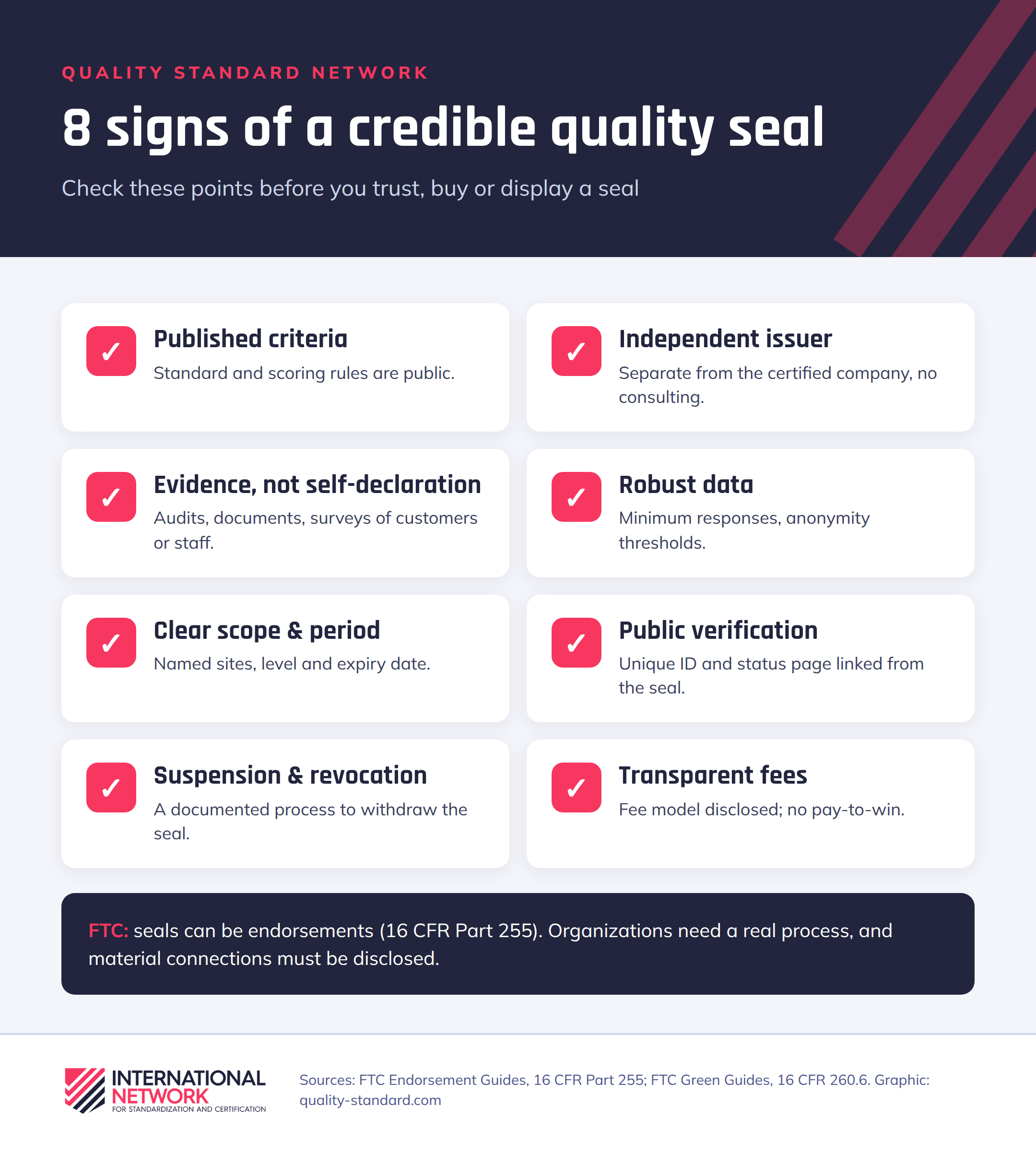
Eight criteria for a credible quality seal
The following checklist translates these principles into questions that anyone can check in a few minutes, usually on the issuer’s website.
1. Published criteria
Can you find the standard or criteria the seal refers to? A credible issuer publishes at least the assessment areas, the scoring logic and the minimum thresholds. A seal without criteria is a logo, not a certification.
2. An independent issuer
Is the issuer separate from the organization that carries the seal? Does it publish how it avoids conflicts of interest, for example by not consulting the companies it certifies? Independence is the difference between third-party certification and self-promotion.
3. Evidence, not self-declaration
What did the assessment rely on? Testing, audits, document review, structured surveys of customers or employees? A questionnaire completed only by the company itself is a self-assessment, even if a third party stamps it.
4. Robust data
For survey-based seals, are there minimum response rates and minimum numbers of responses? Are small subgroups suppressed to protect anonymity? Without such rules, a few hand-picked answers can carry a result.
5. Clear scope and period
Which company, locations, products or services are covered, and until when? A seal that shows only a year, without an expiry date, invites the impression that it never ends.
6. Public verification
Can anyone look up the certificate in a register or on a verification page? Does the seal link to that record? Verification is one of the most effective protections against copied or outdated badges.
7. Suspension and revocation
Can the issuer withdraw a certificate if the conditions are no longer met, and does it say how? A seal that cannot be lost does not say much.
The background to independence and accreditation is explained in our article on conformity assessment.
8. Transparent fees
Who pays, and does the payment depend on the result? A model where the full fee is due only for a positive result can still be credible if it is disclosed and if the assessment itself is independent. A model where anyone who pays receives a seal is not certification.
A short comparison
| Feature | Credible quality seal | Marketing badge |
|---|---|---|
| Criteria | Published, versioned, reviewed regularly | Vague or not published |
| Assessment | Evidence-based, by an independent body | Self-declaration, votes or payment |
| Data | Minimum samples, anonymity thresholds | No stated rules |
| Scope | Named company, sites, period, level | “Certified” without detail |
| Verification | Unique ID and public status page | Downloadable image only |
| Revocation | Documented process with deadlines | None |
What this looks like in practice
Several certification programs in our network apply these principles to workplace and service quality. The United States Institute for Quality (USIQ), our U.S. partner, documents its approach in a public statement on FTC and EmpCo readiness. Each certificate has its own ID and a public verification page showing the employer, covered locations, tier, assessment period, methodology version and status; seal use must link to that page. The page also explains the fee model, the independence rules (no paid HR consulting for assessed employers, a second reviewer for each award) and the revocation process. USIQ is careful to add that the page describes its own design choices and is not a legal determination. Its seal usage guidelines spell out how certified companies may present the seal.
Whether seals actually change behavior is a separate question. Research on employer seals is summarized in USIQ’s article Do Employer Seals Work?, and our earlier post on how seals of approval affect consumer behavior looks at the consumer side. Both point in the same direction: seals help when people trust them, and trust depends on the criteria above.
Advice for companies that want to display a seal
- Ask the issuer for its criteria, its independence policy and a sample verification page before you commit.
- Display the seal only for the scope and period it covers, and link it to the verification record.
- Do not change the seal’s design or wording, and do not suggest that it covers more than it does.
- Remove the seal promptly if it expires or is withdrawn.
- If you have any connection to the issuer beyond a normal certification fee, disclose it.
For a broader view of how certificates and standards relate, see our overview of quality standards.
Frequently asked questions
Is it illegal to display a seal that is not accredited?
No. Many legitimate private certification schemes are not accredited. What the FTC Act prohibits is deception, for example implying independent certification where there was none or implying a broader scope than the seal covers. This article is general information, not legal advice.
Do I have to disclose that I paid for my certification?
According to the FTC’s 2012 Green Guides revision, paying a reasonable certification fee is generally not a material connection that requires disclosure. Other connections, such as ownership or membership requirements, may be.
How can I check whether a seal is genuine?
Look for a verification link or register on the issuer’s website and search for the company. Check the status, scope and expiry date. If there is no way to verify, treat the seal with caution.
What is the difference between a seal and an award?
A seal or certification confirms that published criteria were met. An award ranks or selects winners, often relative to other participants. Both can be credible if the method is transparent and independent.