“Family-friendly” is one of the most frequently used words in U.S. job ads and one of the least defined. For some employers it means a few remote days. For others it means paid parental leave, childcare support and managers who actually allow people to use what the policy promises. Without a quality standard, applicants cannot tell the difference, and employers cannot show it.
This article separates three levels: what U.S. federal law requires, what many employers offer beyond that, and what a measurable family-friendly employer standard should check. It is meant for HR leaders and owners of small and mid-sized businesses who want to build a credible offer and communicate it honestly. Each section compares law vs. best practice, so you can see where the legal minimum ends and a credible family-friendly offer begins.
In short: The federal baseline in the U.S. is narrow. FMLA leave is unpaid and covers only eligible employees of larger employers. The PWFA and the PUMP Act add accommodation and lactation rights. Paid family and medical leave is available to about half of private industry workers. A family-friendly employer standard should therefore measure what goes beyond the legal minimum, and whether employees can actually use it.
The legal baseline: what federal law requires
A quality standard for family-friendly employers starts above the floor that the law sets. In the United States, that floor consists mainly of three federal laws. State and local laws can add more, so employers with staff in several states need to check each location.
Family and Medical Leave Act (FMLA)
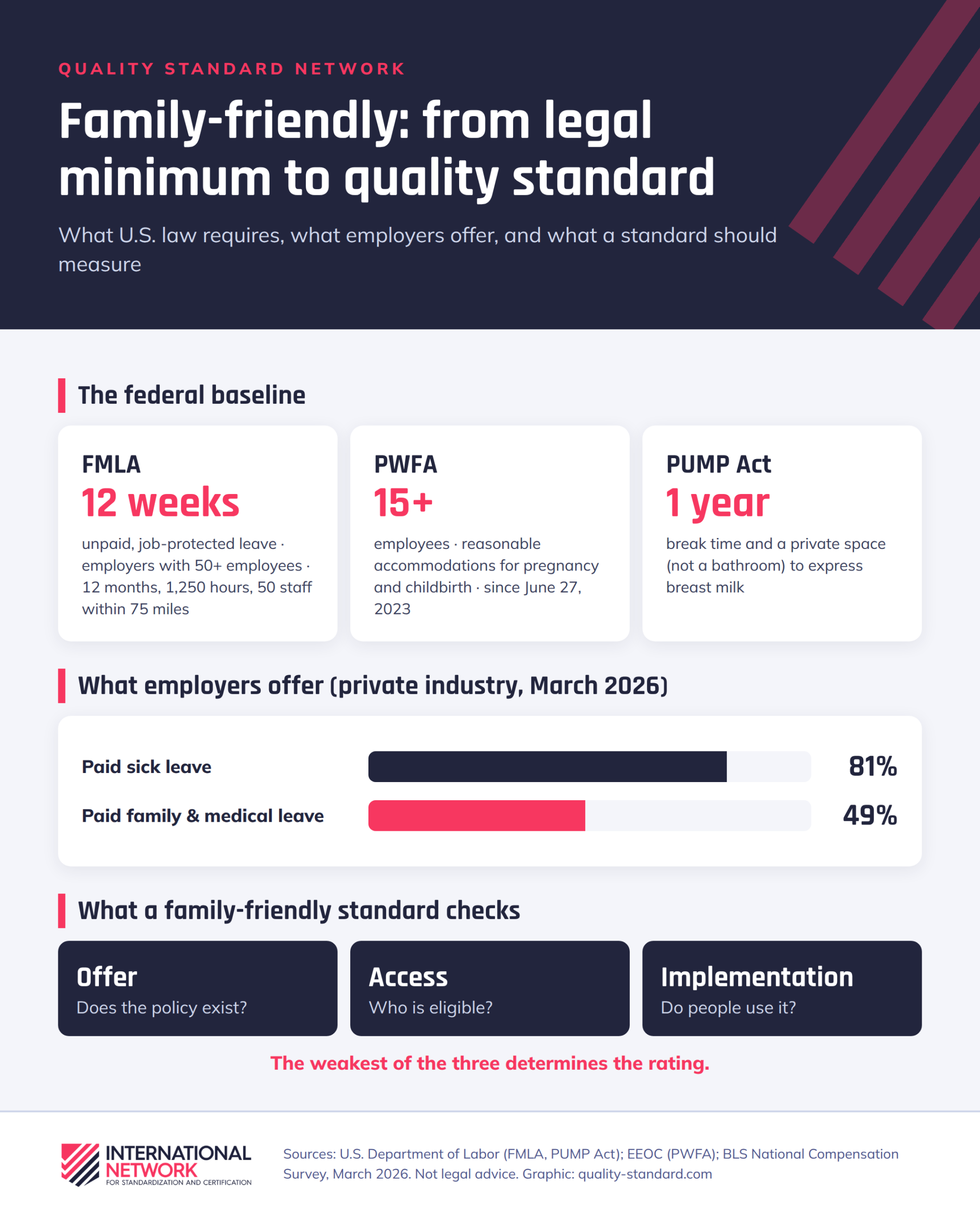
The FMLA gives eligible employees up to 12 workweeks of job-protected leave in a 12-month period for qualifying reasons, including the birth of a child and care for a newborn. The leave is unpaid. Coverage is limited on both sides:
- Private employers are covered if they employ 50 or more employees in 20 or more workweeks in the current or previous calendar year.
- Employees are eligible if they have worked for the employer for at least 12 months, have at least 1,250 hours of service in the 12 months before leave, and work at a location where the employer has at least 50 employees within 75 miles, according to the U.S. Department of Labor.
The practical effect is significant. A study brief for the Department of Labor based on the 2018 FMLA Employee Survey found that a lower hours threshold would raise the eligibility rate by two points to 58%, which implies that only around 56% of employees were eligible under current rules. Employees of small businesses are often not covered at all.
Pregnant Workers Fairness Act (PWFA)
Since June 27, 2023, the PWFA has required employers with at least 15 employees to provide reasonable accommodations for known limitations related to pregnancy, childbirth or related medical conditions, unless the accommodation would cause undue hardship. Examples include additional breaks, the ability to sit, temporary changes to duties or time off for recovery. The law was enacted together with the PUMP Act as part of the Consolidated Appropriations Act, 2023, as Jackson Lewis summarizes.
PUMP for Nursing Mothers Act
The PUMP Act, in effect since December 29, 2022, amended the Fair Labor Standards Act. It extends the right to reasonable break time and a private space, other than a bathroom, to express breast milk for one year after a child’s birth to most employees, including many salaried workers who were not covered before.
What employers actually offer
The gap between the legal minimum and common practice is where family-friendly employers differentiate themselves. The Bureau of Labor Statistics’ National Compensation Survey shows how uneven access still is. In March 2026, 49% of private industry workers had access to paid family and medical leave, compared with 81% who had access to paid sick leave. BLS notes that the paid family and medical leave series uses a revised definition starting in 2025, so the figure cannot be compared directly with older “paid family leave” data.
Access also depends heavily on company size and wage level. In the same survey a year earlier, paid sick leave was available to 73% of workers in establishments with 1 to 49 workers, well below the rate in large establishments. For small employers, this is both a challenge and an opportunity: a well-designed family policy can stand out precisely because it is less common.
What a family-friendly employer standard should measure
A meaningful standard looks beyond the existence of a policy. Three questions matter for every family-related practice:
- Offer: Does the policy exist and is it documented?
- Access: Who is eligible? Are part-time, hourly or remote employees excluded? Are the rules known?
- Implementation: Do employees actually use it without negative consequences? Do managers support it?
A practice is only as strong as its weakest of these three points. A generous parental leave policy that only a fraction of staff can access, or that employees fear to use, should not score as if it were universal.
Core areas
Research and practice point to a set of areas that a family-friendly standard should cover:
- Flexible work and working-time models: flexible hours, part-time options, remote work where the job allows it, predictable schedules for shift workers.
- Pregnancy, parental leave and return to work: paid leave beyond the legal minimum, accommodation processes, structured return-to-work plans, lactation support.
- Childcare, caregiving and family benefits: childcare support or subsidies, dependent care accounts, caregiving leave for elderly relatives.
- Leadership and family-aware management: managers trained to handle family-related requests fairly, meeting times that respect care obligations.
- Fairness and nondiscrimination: equal treatment of parents and non-parents, protection against career penalties after leave.
- Life events and emergencies: bereavement leave, emergency leave, support during family crises.
The employee perspective
Policies describe intentions. Only employees can say whether work and family life actually fit together. That is why a credible standard combines an HR assessment with an anonymous employee survey (see our guide on measuring workplace quality) that asks directly about work-life balance and working-time flexibility, and gives these questions substantial weight.
An example: how the USIQ Family Friendly Employer standard is built
The Family Friendly Employer certification of the United States Institute for Quality (USIQ), a partner in our network, follows this logic. According to its published methodology:
- An employee survey (up to 100 points) gives the two items on work-life balance and working-time flexibility 25 points each, half of the survey score.
- A family-focused HR assessment (up to 100 points) covers 39 criteria in eight areas. Flexible work, parental leave and return to work, and childcare and family benefits are defined as core areas.
- Each criterion is rated separately for offer, access and implementation, and the lowest of the three counts.
- All tiers require minimum scores in the core areas and on the two family items, not only a high total.
- Certificates are valid for 24 months. Reducing or withdrawing a policy in the core areas always counts as a material change that must be reported.
USIQ also states openly that the weights and tiers have not yet been empirically validated and that the program is private and employer-funded, not government accreditation. That kind of transparency is itself a quality criterion. USIQ’s blog covers the practical side in Family Friendly Employer: Policies That Really Matter to Employees and How American Companies Are Becoming More Family-Friendly.
A practical roadmap for small and mid-sized employers
- Check legal compliance first. Confirm your FMLA coverage status, your PWFA accommodation process and your lactation arrangements, plus any state or local leave laws.
- Ask employees what they need. Caregiving needs differ widely. An anonymous survey avoids investing in benefits nobody uses.
- Start with flexibility. Predictable schedules, shift swaps and flexible start times often matter more than expensive benefits, especially for hourly staff.
- Write it down and communicate it. Undocumented flexibility depends on the goodwill of individual managers and is applied unevenly.
- Train managers. Most family policies succeed or fail at the level of the direct supervisor.
- Measure and verify. An independent assessment against a published quality standard shows where the gaps are and gives applicants a reason to believe your claims.
For more on how quality standards work across products, services and workplaces, see our guide to quality standards.
Frequently asked questions
Is FMLA leave paid?
No. The FMLA provides unpaid, job-protected leave. Some states have paid family and medical leave insurance programs, and employers may offer paid leave voluntarily.
Does the PWFA apply to small businesses?
It applies to employers with at least 15 employees. Smaller employers may be covered by state laws.
What makes an employer family-friendly beyond the law?
Paid parental and caregiving leave, flexible and predictable working time, childcare support, structured return-to-work processes, and managers who support the use of these policies.
How can applicants verify a family-friendly claim?
Look for a certification based on published criteria, ideally with a public verification page that shows the scope and validity period.
This article provides general information and is not legal advice. Laws and data cited reflect the sources linked at the time of writing.