Quality standards for products have a long history: you can measure a dimension, test a material, count defects. Quality standards for workplaces are harder. “A good place to work” sounds subjective, and many employer rankings rely on reputation, votes or the company’s own description of its benefits. Yet the quality of a workplace can be measured with the same discipline that applies to any other quality standard: clear criteria, valid instruments, independent assessment and transparent results.
This guide explains what a workplace quality standard should measure, which methods produce reliable results, and how employers in the United States can use such a standard to improve, not only to market themselves.
In short: A credible employer quality standard combines two perspectives: what employees experience (measured through an anonymous, structured survey) and what the employer actually has in place (measured through an evidence-based HR assessment). Minimum response rates, anonymity thresholds, published scoring rules and a limited validity period separate a real standard from an award that anyone can buy.
Why workplace quality deserves a standard
The business case is not new. Gallup’s research on engagement, based on its Q12 instrument, links engaged teams to better outcomes on profitability, productivity, customer satisfaction and retention. The trend in the United States is not encouraging: Gallup reports that the share of engaged U.S. employees fell from 36% in 2020 to 31% in 2025, which it estimates as about 8 million fewer engaged workers. Gallup also found that the steepest declines were in clarity about expectations and in feeling cared about as a person.
For a quality professional, that list reads like a set of process failures: unclear requirements, missing feedback loops, weak leadership practices. Those are exactly the things a quality standard is designed to make visible and manageable. The ISO quality management principle of engagement of people makes the same point from the other direction: competent, empowered and engaged people are essential to delivering value.
What should be measured: two perspectives
Most failed employer ratings make one of two mistakes. Either they ask only the employer, who naturally describes its intentions, or they ask only a self-selected group of employees online, whose views may not represent the workforce. A robust standard uses both perspectives and checks them against each other.
Perspective 1: the employee experience
An anonymous employee survey captures how policies actually feel on the ground. Typical dimensions include:
- the company overall (direction, trust in leadership)
- working conditions and environment (workload, tools, safety, flexibility)
- the work itself (meaning, autonomy, clarity of expectations)
- learning and development
- team and climate
- the direct manager
- satisfaction and loyalty (would people stay, would they recommend the employer)
Perspective 2: the HR system
An HR assessment captures what the organization has actually put in place: how work is organized, how leaders are selected and developed, how pay and benefits are structured, how fairness and inclusion are handled, how candidates are treated, and how people leave the company. The crucial word is evidence. A policy that exists only in a slide deck should not score the same as one that is documented, communicated and used.
When both perspectives agree, the result is credible. When they diverge, for example a generous parental leave policy that employees rate poorly because managers discourage its use, the gap itself is the most useful finding for improvement.
How to make the measurement reliable
A survey is only a measuring instrument if it meets basic methodological standards. These are the points that matter most in practice.
Representative participation
Every employee should be invited, not a selection chosen by management. Minimum response rates and minimum numbers of responses prevent a result from resting on a handful of enthusiastic or disgruntled voices. Sensible thresholds depend on company size: a small team needs a high response rate, a large organization a higher absolute number.
Anonymity that holds
Employees answer honestly only if they believe their answers cannot be traced. Results should never be reported for groups below a minimum size, typically five respondents. Personal data should not be processed in ways that could identify individuals.
Consistent scales and published scoring
Using the same response scale for all scored items, and publishing how answers are converted into points, allows results to be compared across companies and over time. It also lets the employer understand exactly why it scored the way it did.
Evidence levels for HR criteria
Rating HR practices on an evidence scale, from “not in place” through “stated but not substantiated” to “verified,” turns a self-description into an assessment. Reviewers can request documents, compare them with survey findings and use public sources.
Minimums, not just totals
A high average can hide a serious weakness. Requiring a minimum score in every dimension prevents an employer from compensating, say, very poor management quality with an attractive benefits package.
Limited validity and verification
Workplaces change. A certification should expire after a defined period, and anyone should be able to check its current status online.
An example: how the USIQ Top Employer standard is built
The Top Employer certification of the United States Institute for Quality (USIQ), a partner in our network, applies these principles to the U.S. market. According to its published methodology (criteria version 2026-3.2):
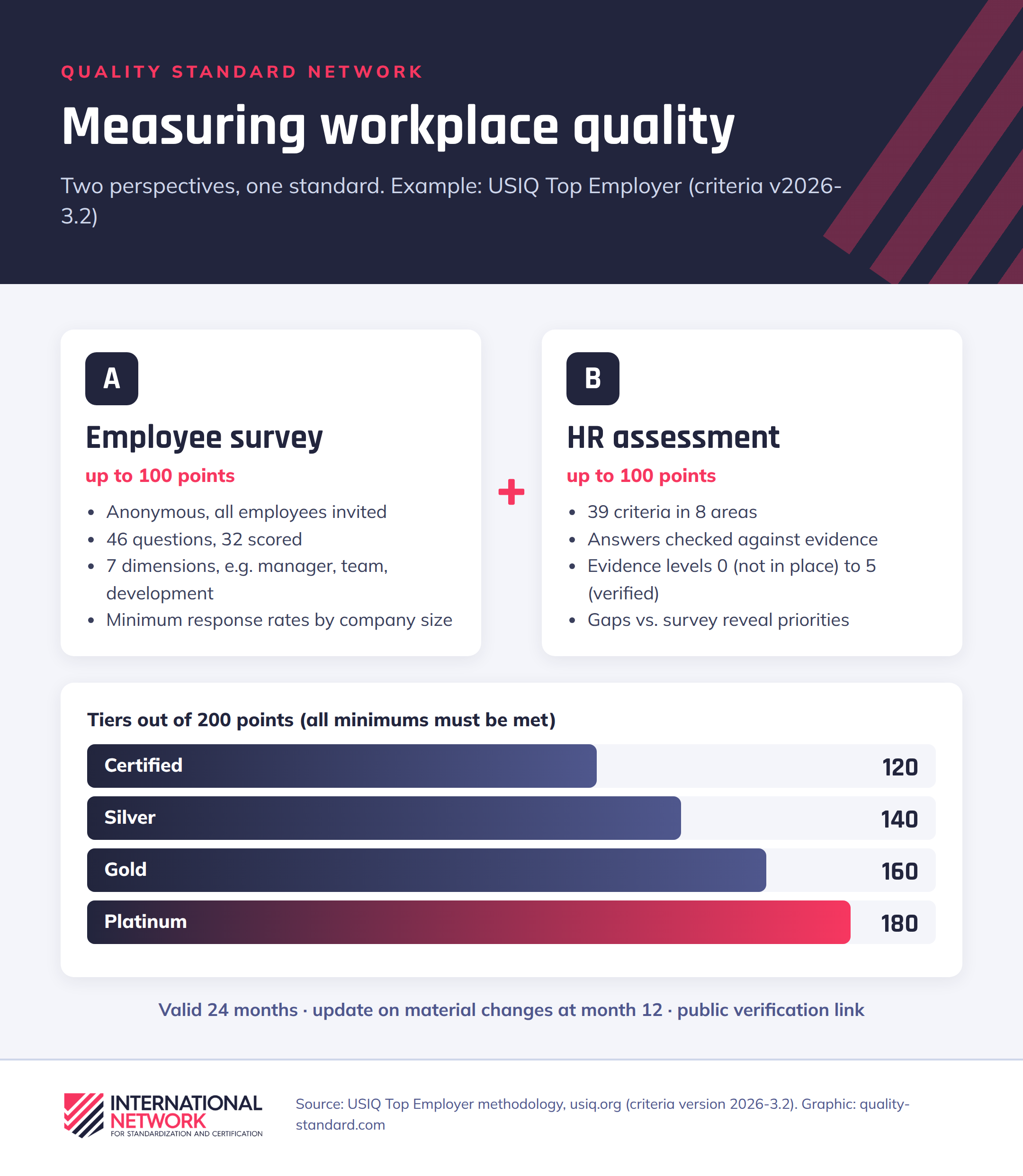
- Employee survey, up to 100 points: 46 questions, 32 of them scored, across seven dimensions, from “Company overall” to “Satisfaction and loyalty.”
- HR assessment, up to 100 points: 39 criteria in eight areas, including work organization, leadership, people development, flexibility, compensation and benefits, culture and fairness, employer branding and candidate experience, and transitions and separations. An authorized representative answers each criterion, and reviewers assess the answers against selected evidence on a scale from 0 (not in place) to 5 (verified).
- Tiers: Certified, Silver, Gold and Platinum require 120, 140, 160 or 180 of 200 points, plus minimums for each component and for every survey dimension.
- Participation rules: for example, at least 50% and 5 responses for employers with 10 to 39 employees, and at least 20% and 200 responses for 1,000 or more employees. Results are not reported for subgroups with fewer than five valid responses.
- Validity: 24 months, with a written update on material changes at month 12, a unique certificate ID and a public verification link.
Whether you work with USIQ or another provider, these are the kinds of details worth asking for. USIQ’s own blog explains how to design employee surveys that staff trust and leaders act on, and what makes the best employers stand out.
From measurement to improvement
A workplace quality standard earns its keep after the result is in. The most useful outputs are not the seal, but the detailed findings:
- Prioritize gaps, not averages. Look for dimensions that fall below the minimum, and for large differences between the HR assessment and the employee experience.
- Share results with employees. People who took the time to answer want to know what happened. A short summary and two or three concrete commitments build trust for the next survey.
- Assign owners and dates. Treat each improvement like a corrective action in a quality management system, with a responsible manager and a check on effectiveness.
- Re-measure. A second assessment after the validity period shows whether changes worked.
Common pitfalls
- Surveying only selected teams. It inflates results and undermines credibility.
- Changing questions every year. It makes trends impossible to read.
- Reporting tiny groups. It breaks anonymity and future participation.
- Using the seal without the scope. A certificate for one location should not be presented as covering the whole company.
- Ignoring the “why.” Scores show where problems are. Follow-up conversations show what causes them.
For the broader context of how quality standards and certification relate, see our guide to quality standards and our article on conformity assessment.
Frequently asked questions
Is an employer certification the same as an employer award?
Not necessarily. A certification confirms that published criteria were met; several employers can meet them at the same time. An award usually ranks or selects winners. Both can be meaningful if the method is transparent.
How many employees need to answer the survey?
It depends on company size. Good standards set both a minimum response rate and a minimum number of responses, with higher absolute numbers for larger employers.
Can a small company with 10 or 20 employees be assessed?
Yes, if the standard sets appropriate thresholds for small teams and protects anonymity. In very small groups, results should be reported only at company level.
Does a certified employer have to keep its policies?
A credible standard requires the employer to report material changes during the validity period and allows the certificate to be suspended or withdrawn if conditions are no longer met.