

Product quality can be inspected before a product leaves the factory. Service quality cannot. A service is produced and consumed at the same moment, it depends on the people who deliver it, and the customer judges it against expectations that differ from person to person. That is why service quality standards look different from product standards, and why measuring them requires the customer’s voice.
This guide explains the established frameworks for defining and measuring service quality, from the SERVQUAL model to the ISO 10000 family of customer satisfaction standards, and shows how a company can turn them into a measurable quality standard for its own customer service. It also explains what an independent body checks when it is asked to certify customer service.
In short: Service quality is the gap between what customers expect and what they experience. SERVQUAL measures it across five dimensions: reliability, assurance, tangibles, empathy and responsiveness. ISO 10002 guides complaints handling, and ISO 10004 guides how to monitor and measure customer satisfaction. A credible service certification combines a survey of the company’s own customers with an evidence-based review of service processes.
Why service quality needs its own standards
Three features make services hard to standardize:
- Intangibility: there is no object to test. Quality has to be inferred from outcomes and experiences.
- Variability: the same service can be delivered very differently by two employees, or by one employee on two days.
- Simultaneity: production and consumption happen together, so errors reach the customer immediately.
Service quality standards therefore focus on two things: the processes and conditions that make good service likely (training, response times, complaint handling) and the customer’s own judgment of the result.
SERVQUAL: the five dimensions of service quality
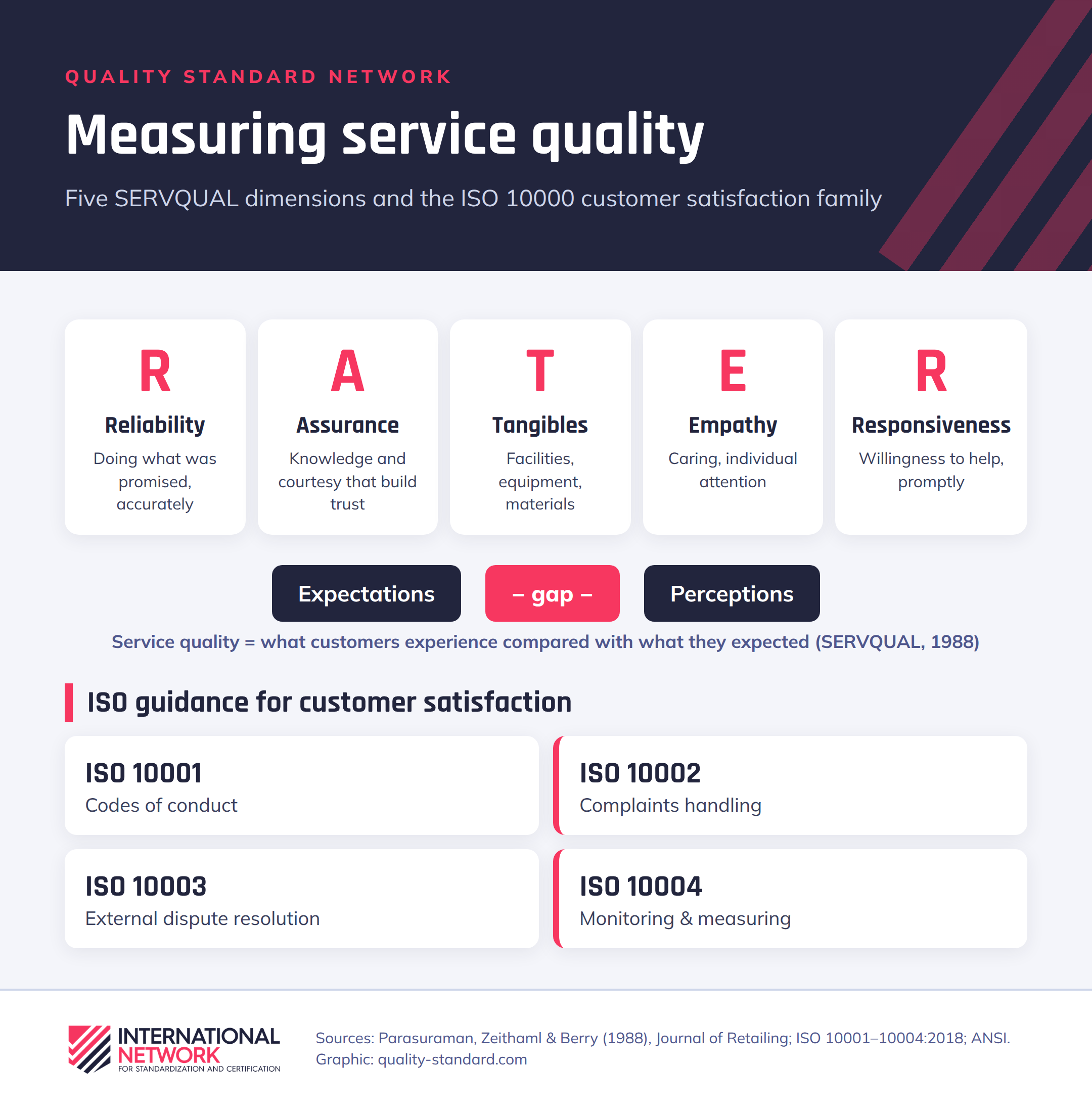
The most widely cited model comes from the marketing researchers A. Parasuraman, Valarie Zeithaml and Leonard Berry. Their 1985 article in the Journal of Marketing introduced a gaps model of service quality, and their 1988 article in the Journal of Retailing, “SERVQUAL: A Multiple-Item Scale for Measuring Consumer Perceptions of Service Quality,” turned it into a 22-item questionnaire. Their early research had identified ten criteria customers use; testing consolidated them into five dimensions, often remembered as RATER:
| Dimension | Meaning | Example of a measurable standard |
|---|---|---|
| Reliability | Performing the promised service dependably and accurately | Share of orders delivered on the promised date |
| Assurance | Knowledge and courtesy of employees and their ability to inspire trust | Training hours per customer-facing employee; first-contact resolution |
| Tangibles | Appearance of facilities, equipment, staff and communication materials | Clarity of invoices, website usability, condition of premises |
| Empathy | Caring, individualized attention | Convenient hours; named contact person for key accounts |
| Responsiveness | Willingness to help and to provide prompt service | Response time to inquiries; callback within a set time |
SERVQUAL has been criticized and refined over the years. Several studies did not reproduce the five-factor structure in every industry, and researchers have argued that the instrument needs to be adapted to the specific service setting, as Francis Buttle argued in his widely cited review of SERVQUAL in the European Journal of Marketing (1996). Its lasting contribution is the idea that service quality must be measured from the customer’s perspective, across several distinct dimensions, rather than as a single satisfaction score.
The ISO 10000 family: customer satisfaction standards
Customer focus is the first of the seven quality management principles, and ISO 9001 requires certified organizations to monitor customer satisfaction. In ISO 9001:2015 this was worded as monitoring customers’ perceptions of how well their needs and expectations have been met; ISO 9001:2026 simplifies clause 9.1.2 to monitoring customer satisfaction and names complaints and social media as possible sources. A group of guidance standards, all developed in the ISO quality management family, explains how to do this well:
- ISO 10001:2018 gives guidelines for customer satisfaction codes of conduct, meaning the promises an organization makes to customers.
- ISO 10002:2018 gives guidelines for complaints handling. ANSI describes it as guidance to plan, design, develop, operate, maintain and improve an effective and efficient complaints-handling process, with top management involvement and a customer-focused environment. It can be used as one of the processes of an overall quality management system.
- ISO 10003:2018 covers dispute resolution outside the organization.
- ISO 10004:2018 gives guidelines for monitoring and measuring customer satisfaction. ISO lists it as reviewed and confirmed in 2023, so the 2018 edition remains current.
One sentence in ISO 10004 is worth quoting in spirit to every service manager. As ANSI summarizes the standard, complaints are a common indicator of low customer satisfaction, but their absence does not necessarily imply high customer satisfaction. Many dissatisfied customers simply leave without saying anything. A service quality standard that relies on complaint counts alone measures only the customers who bothered to speak up.
Building a measurable service quality standard
Whether a company wants to improve internally or seek certification, the same building blocks apply.
1. Define your service promises
Write down what customers can expect: response times, availability, accuracy, what happens when something goes wrong. Promises should be specific enough to measure. “Excellent service” is not a standard; “every inquiry answered within one business day” is.
2. Make service accessible
Customers should be able to reach the company through the channels they use, with clear information about when and how. Long hold times and hidden contact details are among the most common sources of frustration.
3. Handle complaints as a process
Following ISO 10002, complaints should be acknowledged, tracked, resolved within defined times and analyzed for root causes. The goal is service recovery for the individual customer and fewer repeat problems for everyone else.
4. Train and empower staff
Customer-facing employees need the knowledge to answer questions and the authority to solve common problems without escalation. Assurance and responsiveness both depend on it.
5. Measure the customer’s view regularly
Use a structured survey across the relevant dimensions, invite a representative sample of real customers, set minimum response numbers, and treat unanswered items as missing rather than as positive. Compare results over time and across teams or locations.
6. Close the loop
Results only matter if they lead to action. Assign owners for improvements, check whether they work, and tell customers what changed.
How service certification works in practice
A service certification applies these ideas through an independent assessment. The Top Service certification of the United States Institute for Quality (USIQ), a partner in our network, is one example. Its published methodology (criteria version 2026-1) works like this:
- A customer survey worth up to 80 of 100 points, with 24 scored questions across seven dimensions: overall impression, accessibility and responsiveness, advice and expertise, reliability and keeping promises, communication and courtesy, problem resolution, and satisfaction and loyalty. Skipped answers are excluded rather than counted as favorable.
- A management assessment worth up to 20 points, with 20 criteria in five areas that mirror the building blocks above: service standards and customer promises, accessibility and contact channels, complaint handling and service recovery, staff training and empowerment, and measuring and improving service. Answers are checked against selected documents and rated on an evidence scale.
- Eligibility and sample rules: at least 50 customers with a purchase, contract or service contact in the previous 12 months, and minimum response rates that scale with the number of invited customers.
- Tiers and validity: Certified, Silver, Gold and Platinum, each with minimums for every dimension, valid for 24 months with a unique verification link.
The structure shows how the academic and ISO frameworks translate into a practical certification: customer perception carries most of the weight, while the process review checks whether good results rest on a system or on luck. USIQ’s blog explains which customer survey questions work and how a Top Service seal can support sales.
For a wider view of the different kinds of standards for products, processes, services and workplaces, see our guide to quality standards.
Frequently asked questions
Is there an ISO certification for customer service?
ISO 10002 and ISO 10004 are guidance standards, written with “should” rather than “shall.” Organizations use them to design their processes, but they are not intended as certification standards in the way ISO 9001 is. Customer satisfaction monitoring is, however, a requirement within ISO 9001.
What is the difference between service quality and customer satisfaction?
Service quality describes how well the service is delivered across dimensions such as reliability and responsiveness. Customer satisfaction is the customer’s overall judgment of whether expectations were met. The two are closely related, and both are measured from the customer’s perspective.
How many customers need to respond for a reliable result?
It depends on the size of the customer base. Good practice sets both a minimum response rate and a minimum number of responses, and excludes items with too few valid answers.
Is a low number of complaints a sign of good service?
Not on its own. Many dissatisfied customers do not complain; they leave. Complaint data should be combined with a structured satisfaction survey.