
Every ISO quality management standard rests on the same foundation: seven quality management principles. They are short, almost obvious statements, yet most of the requirements in ISO 9001 can be traced back to one of them. If you understand the principles, you understand why the standard asks for what it asks, and you can apply the same thinking to any quality standard, including standards for workplaces and customer service.
This article walks through each principle, shows what it looks like in a small or mid-sized U.S. company, and points out the typical mistakes. It also explains how the principles changed in 2015 and why one of them, engagement of people, is harder to fake than the others.
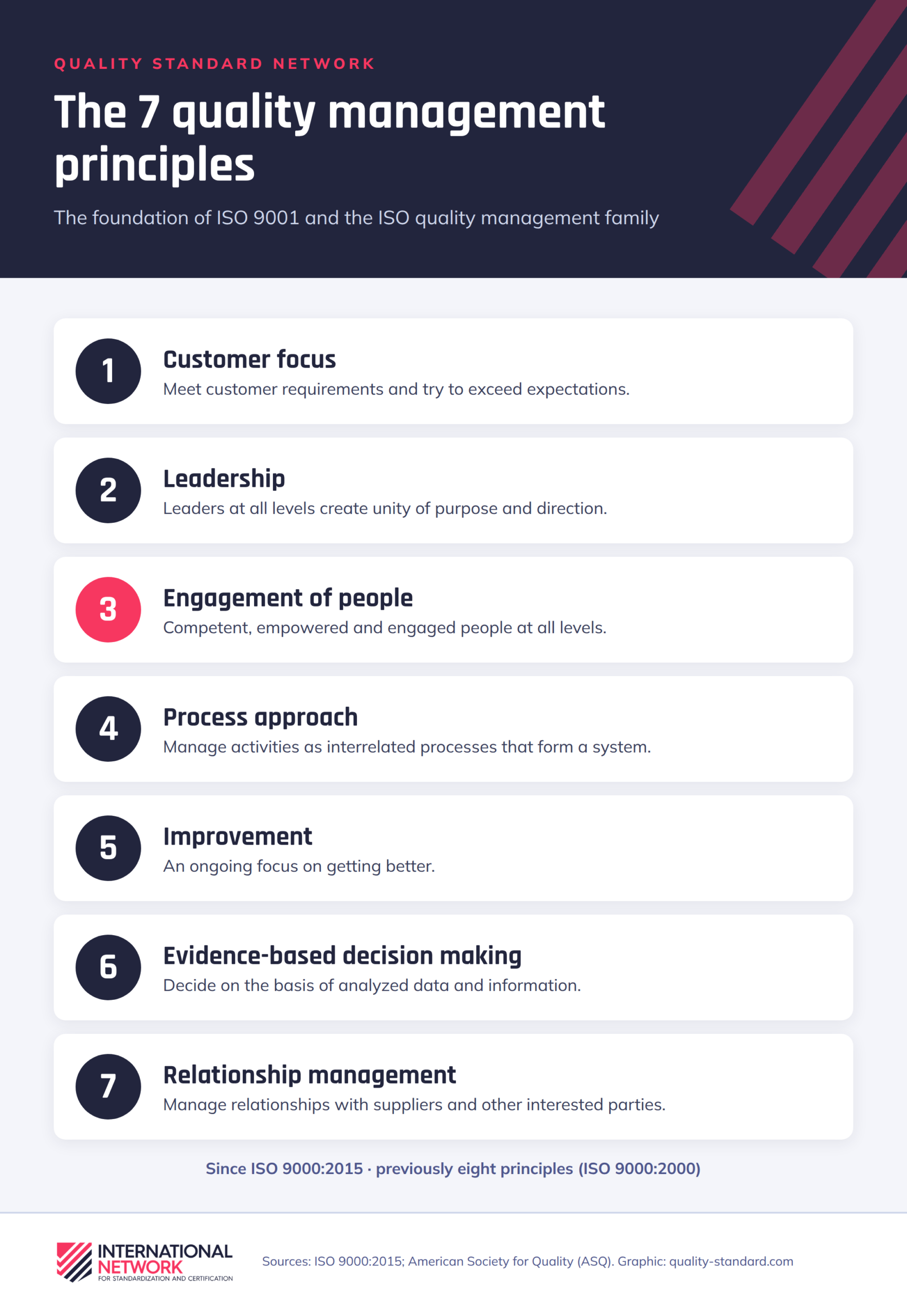
The seven principles (ISO 9000, unchanged in the 2026 edition): 1. Customer focus · 2. Leadership · 3. Engagement of people · 4. Process approach · 5. Improvement · 6. Evidence-based decision making · 7. Relationship management. They are not requirements themselves. They are the beliefs from which the requirements of ISO 9001 and related standards are derived.
Where the principles come from
The principles are defined in ISO 9000, the standard that sets out the fundamentals and vocabulary for quality management systems. The American Society for Quality (ASQ) summarizes the history: the 2000 revision of ISO 9000 introduced eight principles, and for the 2015 update a technical group reduced the eight to seven. “Involvement of people” became “engagement of people,” and the former “system approach to management” was folded into the process approach.
ASQ also notes that the principles reflect the legacy of the great figures of quality management, including W. Edwards Deming, Joseph Juran, Walter Shewhart and Kaoru Ishikawa. That matters, because it explains the tone: the principles are about how an organization thinks, not about paperwork.
1. Customer focus
The first principle says that the primary focus of quality management is to meet customer requirements and to try to exceed customer expectations. The rationale is simple: an organization succeeds over time when it earns and keeps the confidence of its customers and other interested parties.
In practice: know who your customers are, including future ones; translate their needs into internal requirements; measure satisfaction regularly; and treat complaints as data, not as nuisance. A plumbing company that tracks callbacks and reasons for repeat visits is applying this principle more seriously than a large firm that only sends an annual satisfaction email.
How to measure the customer side properly is covered in our guide to service quality standards.
Common mistake: measuring satisfaction without acting on it. A survey is only part of customer focus if its results lead to decisions.
2. Leadership
Leaders at all levels establish unity of purpose and direction and create the conditions in which people can work toward the organization’s quality objectives. The key words are “at all levels.” Leadership in this sense includes a shift supervisor and a project lead, not only the CEO.
In practice: a clear mission and quality objectives that people can repeat in their own words; resources that match those objectives; and leaders who model the behavior they ask for. If the policy says “quality first” but the bonus plan rewards speed alone, the principle is broken.
Common mistake: treating the quality policy as a framed document. ISO 9001 requires top management to take accountability for the effectiveness of the system. Auditors look for evidence that leaders actually review results and decide on actions.
3. Engagement of people
Competent, empowered and engaged people at all levels are essential to an organization’s ability to create and deliver value. The 2015 wording deliberately moved from “involvement” to “engagement.” Involving people means asking for their input. Engaging them means they understand why their work matters and have the authority and skills to improve it.
This principle is also where quality management meets employer quality. Engagement cannot be declared; it shows up in how people experience their work. Gallup, which has tracked U.S. engagement since 2000, reports that 31% of U.S. employees were engaged in 2025, and that managers account for at least 70% of the variance in team engagement. In other words, more than two out of three employees in a typical company are not fully engaged, and the immediate manager has the biggest influence on whether that changes.
In practice: clear roles and expectations; training that matches the job; recognition of contributions; and regular, honest feedback channels in both directions. An anonymous employee survey with transparent follow-up is one of the most direct ways to check whether this principle works. The USIQ Top Employer certification, for example, measures dimensions such as “Your manager,” “Learning and development” and “Team and climate” through a structured employee survey and checks the related HR practices against evidence.
Our article on how workplace quality can be measured explains the methods in more detail.
Common mistake: confusing engagement with satisfaction or perks. A free lunch does not make people feel competent or empowered.
4. Process approach
Consistent and predictable results are achieved more effectively when activities are understood and managed as interrelated processes that work together as a system. A process turns inputs into outputs; the output of one process is often the input of the next. Problems tend to arise at the hand-offs.
In practice: map your core processes (for example, quote to order, order to delivery, hire to onboard); define who owns each one; agree on the inputs, outputs and measures; and manage the interfaces. Risk-based thinking, which ISO 9001:2015 made explicit, belongs here too: identify what could go wrong in a process and decide how to prevent it.
Common mistake: documenting processes in great detail while nobody looks at the hand-offs. Many quality failures happen between departments, not within them.
5. Improvement
Successful organizations have an ongoing focus on improvement. The 2015 wording dropped the word “continual” from the title, but the meaning is the same: improvement is not a project with an end date. It includes small, frequent fixes as well as larger breakthrough changes.
In practice: a working corrective-action process that looks for root causes, not just symptoms; time and budget reserved for improvement; and a habit of learning from both failures and successes. A plan-do-check-act cycle is the classic tool.
Common mistake: closing corrective actions on paper without checking whether the problem actually stopped recurring.
6. Evidence-based decision making
Decisions based on the analysis and evaluation of data and information are more likely to produce the desired results. This principle replaced the older “factual approach to decision making.” The shift in language recognizes that data always needs interpretation and that some uncertainty remains.
In practice: decide which few indicators really matter; make sure the data is accurate and accessible; analyze it with appropriate methods; and balance it with experience and judgment. For people-related questions, this means using valid survey instruments with sufficient response rates rather than anecdotes from the loudest voices.
Common mistake: collecting dozens of metrics nobody uses. Fewer, better measures beat a dashboard nobody trusts.
7. Relationship management
For sustained success, organizations manage their relationships with interested parties such as suppliers, partners, investors, employees and the community. The earlier version focused on “mutually beneficial supplier relationships”; the 2015 principle widened the circle.
In practice: identify the interested parties that matter most; share information and plans with key suppliers; develop joint improvement activities; and recognize partner contributions. Long-term supplier partnerships often deliver more quality improvement than constant switching to the lowest bidder.
Common mistake: treating suppliers only as a cost line. Many quality problems enter the organization through purchased materials and services.
How the principles connect to ISO 9001 certification
The principles themselves are not auditable requirements. ISO 9001 is the requirements standard, and it is what a certification body audits. But each clause has a recognizable root: customer satisfaction monitoring comes from customer focus, management review from leadership and evidence-based decision making, competence and awareness requirements from engagement of people, and so on. ISO 9000:2026, published in May 2026, keeps all seven principles, and the current requirements standard is ISO 9001:2026, published on 16 September 2026. What changed compared with the 2015 edition is explained in our guide to ISO 9001:2026.
That is also why the principles are a useful lens for evaluating any quality standard, not just ISO 9001. A credible standard for employers or for customer service should be able to show how its criteria serve these same ideas. If you want to explore the bigger picture, our guide to quality standards explains the main types, and USIQ’s article ISO 9001 Certification Explained covers what certification involves for U.S. employers in practical terms.
A self-check for your organization
| Principle | Question to ask | Evidence that it works |
|---|---|---|
| Customer focus | Do we know why customers stay or leave? | Satisfaction and complaint data that lead to documented actions |
| Leadership | Can employees name our quality objectives? | Objectives that are measured and reviewed by management |
| Engagement of people | Do people feel competent and heard? | Anonymous survey results and visible follow-up |
| Process approach | Who owns each core process and its hand-offs? | Process maps with owners and measures |
| Improvement | Do problems stop recurring after we fix them? | Corrective actions verified for effectiveness |
| Evidence-based decisions | Which three numbers drive our decisions? | Reliable data reviewed at fixed intervals |
| Relationship management | Which partners are critical to our quality? | Joint plans and performance reviews with key suppliers |
Frequently asked questions
Are the seven principles part of ISO 9001?
They are defined in ISO 9000 and form the basis of ISO 9001, but they are not themselves auditable requirements. ISO 9001 translates them into specific requirements.
Why were there eight principles before?
The 2000 edition of ISO 9000 listed eight. In 2015, the system approach to management was merged into the process approach, and some principles were renamed, which left seven.
Do the principles apply to small businesses?
Yes. ISO quality management standards are designed for organizations of any size and sector. A ten-person company applies them with less documentation, but the logic is the same.
Which principle is hardest to verify?
Engagement of people, because it cannot be read from documents. Whether people feel competent, empowered and heard has to be measured through their own experience, for example with an anonymous employee survey.