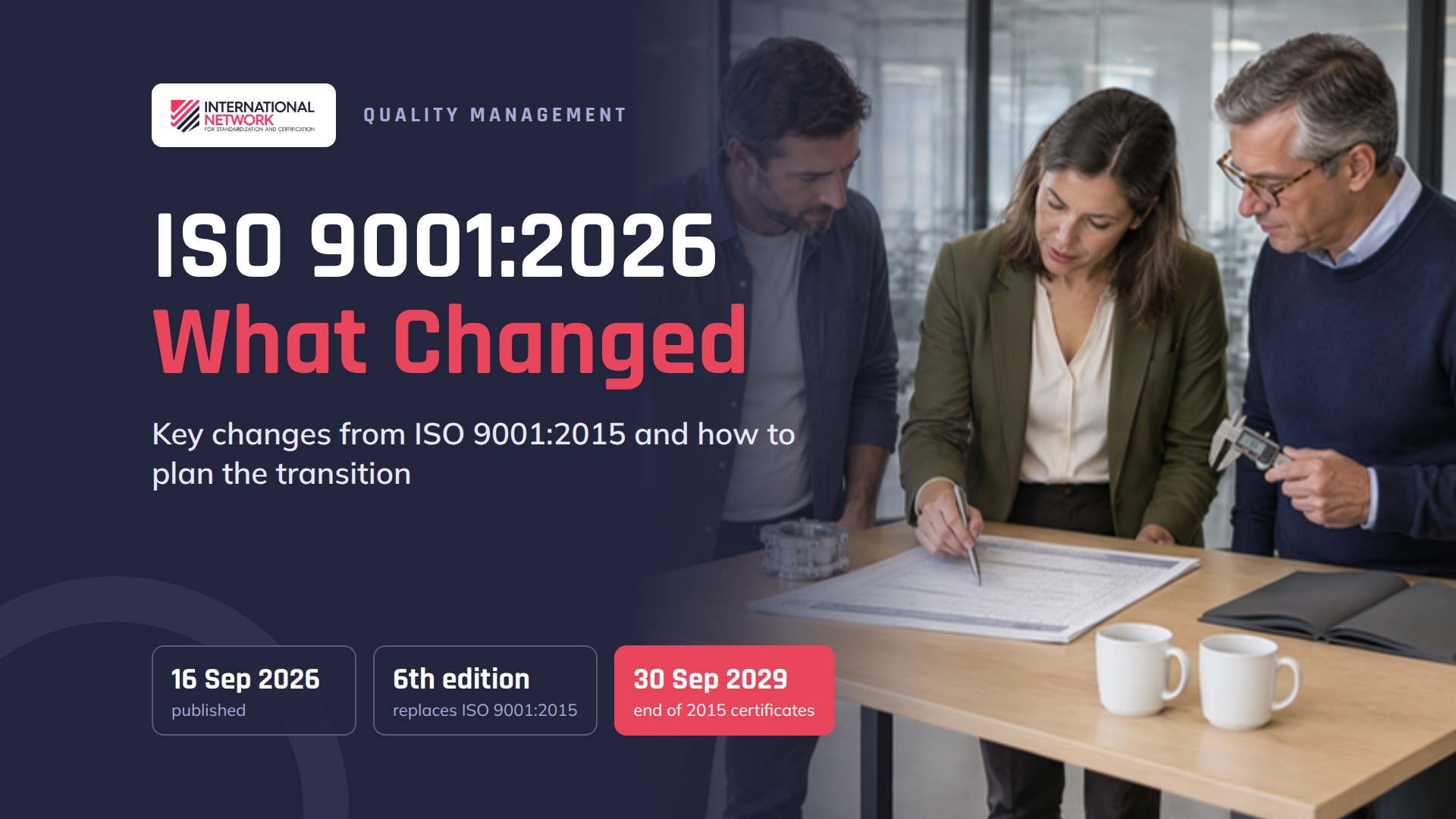
ISO 9001 is the most widely used management system standard in the world, and for eleven years its requirements barely moved. That ended on 16 September 2026, when ISO published ISO 9001:2026, the sixth edition of the standard. It replaces ISO 9001:2015, including the climate change amendment of 2024, and every organization that holds an ISO 9001 certificate now has to move to the new edition within a fixed transition period.
The good news first: ISO 9001:2026 is not a new standard. The ten-clause structure stays, the process approach stays, and an organization with a working quality management system will recognize almost every requirement. The changes are concentrated in a handful of clauses, but some of them go deeper than a reworded sentence. Top management must now actively promote a culture of quality and ethical behavior, risks and opportunities are handled in separate requirements, the planning of changes has grown from four to seven considerations, and continual improvement has been rebuilt as a single clause.
This guide explains what ISO 9001:2026 contains, what changed compared with ISO 9001:2015 clause by clause, which dates apply to the transition and how to plan it without wasting audit days. It is written for quality managers, managing directors and consultants in small and mid-sized companies who need a clear picture rather than a sales pitch for training courses.
In short: ISO 9001:2026 was published on 16 September 2026 and replaces ISO 9001:2015. The structure is unchanged. The most important changes concern quality culture and ethical behavior (5.1.1 and 7.3), separate actions for risks and for opportunities (6.1.2 and 6.1.3), a broader planning of changes (6.3), organizational knowledge (7.1.6) and a merged clause on continual improvement (10.1). Existing ISO 9001:2015 certificates remain valid until 30 September 2029. From 31 March 2028, new accredited certifications are only issued to the 2026 edition.
ISO 9001:2026 at a glance
Before going into the details, the key facts about the new edition in one place. The dates for the transition come from the rules of the international accreditation system, which certification bodies such as DNV and LRQA have passed on to their clients.
| Item | ISO 9001:2026 |
|---|---|
| Full title | ISO 9001:2026, Quality management systems, Requirements |
| Edition | Sixth edition (after 1987, 1994, 2000, 2008 and 2015) |
| Publication date | 16 September 2026 |
| Replaces | ISO 9001:2015 and its Amendment 1:2024 (climate change) |
| Responsible committee | ISO/TC 176/SC 2, Quality systems |
| Structure | Harmonized structure for ISO management system standards, clauses 1 to 10 |
| Terms and definitions | Core management system terms listed in clause 3, ISO 9000:2026 as normative reference |
| Transition period | Three years from publication |
| New initial certifications to ISO 9001:2015 | Not possible from 31 March 2028 |
| End of validity of ISO 9001:2015 certificates | 30 September 2029 |
Why ISO 9001 was revised after eleven years
ISO reviews every standard at least every five years. In 2021, the responsible subcommittee voted to confirm ISO 9001:2015 without changes. Two years later, that position was reversed and the revision project started in 2023. The reasons were less about flaws in the 2015 text and more about how much the environment of companies had changed: supply chains broke during the pandemic, digital tools changed how processes are run and documented, and customers, investors and regulators began to ask about ethics, culture and climate risks.
Part of this had already found its way into the 2015 edition. In February 2024, ISO published Amendment 1:2024, which added two short sentences on climate change to clauses 4.1 and 4.2. Organizations had to determine whether climate change is a relevant issue for them, and a note reminded them that interested parties can have climate-related requirements. The amendment had no transition period. ISO 9001:2026 now carries these provisions forward as part of the regular text, so they are not new requirements for organizations that already took the amendment seriously.
A second driver was consistency. Since 2021, ISO uses an updated harmonized structure for all management system standards, with identical clause titles, core text and core definitions. ISO 14001, ISO 45001 and ISO/IEC 27001 have been or are being aligned with it. ISO 9001:2026 follows the same model, which makes integrated management systems easier to build and to audit.
The revision timeline from ISO 9001:2015 to ISO 9001:2026
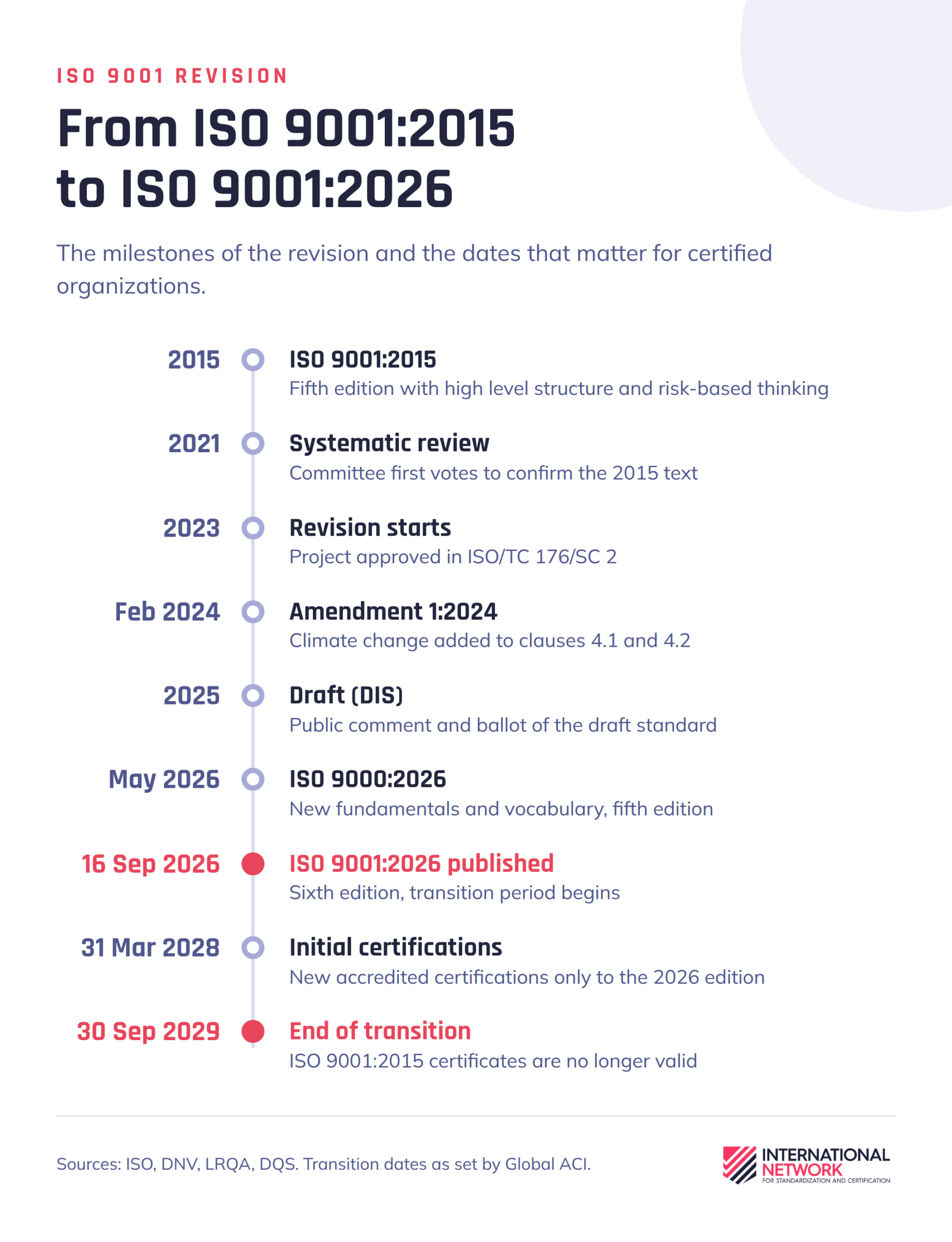
An ISO standard passes through fixed stages before it is published. Comments are possible at the committee draft and at the Draft International Standard (DIS) stage. At the Final Draft International Standard (FDIS) stage, the national members only vote on the text, and no further technical changes are made. The table shows the milestones of the ISO 9001 revision and the transition dates that followed.
| Date | Milestone |
|---|---|
| September 2015 | ISO 9001:2015 published (fifth edition) |
| 2021 | Systematic review: subcommittee votes to confirm the 2015 edition without revision |
| 2023 | Revision project approved, work starts in ISO/TC 176/SC 2 |
| February 2024 | Amendment 1:2024 adds climate change to clauses 4.1 and 4.2 |
| 2025 | Draft International Standard (DIS) published for comment and ballot |
| May 2026 | ISO 9000:2026 (fifth edition, fundamentals and vocabulary) published |
| Spring and summer 2026 | Final Draft International Standard (FDIS) ballot, approved |
| 16 September 2026 | ISO 9001:2026 published, transition period begins |
| 31 March 2028 | New initial accredited certifications only to ISO 9001:2026 |
| 30 September 2029 | ISO 9001:2015 certificates are no longer valid |
What stays the same in ISO 9001:2026
Most of the standard is unchanged in substance, and it is worth saying this clearly before looking at the changes. Organizations that rebuild their whole system because a new edition has appeared spend money without gaining anything.
- The ten clauses and their titles remain: scope, normative references, terms and definitions, context of the organization, leadership, planning, support, operation, performance evaluation and improvement.
- The process approach and the Plan-Do-Check-Act cycle remain the basic logic of the standard.
- Risk-based thinking stays central. The standard still does not require a formal risk management method such as ISO 31000.
- The standard remains technology neutral. There is no separate requirement for artificial intelligence or for any specific software.
- There is still no requirement for a quality manual or for a fixed number of documented procedures. Organizations decide which documented information they need.
- Clauses 8.5.4 to 8.5.6, 8.6 and 8.7 (preservation, post-delivery activities, control of changes, release of products and services, nonconforming outputs) are essentially unchanged.
- The informative Annex A was greatly expanded, but it adds no requirements.
Certification bodies describe the overall extent of change as moderate and smaller than the step from ISO 9001:2008 to ISO 9001:2015. DNV, for example, expects that organizations already certified to the 2015 edition will not face major implementation challenges.
ISO 9001:2026 vs. ISO 9001:2015: the changes clause by clause
The following overview is based on the comparison of the 2015 and 2026 texts published by certification bodies and specialist publishers, in particular DNV, DQS and Advisera. The impact rating reflects how much work a typical organization will have, not how many words changed. Where the sources differ, the more cautious reading was chosen.
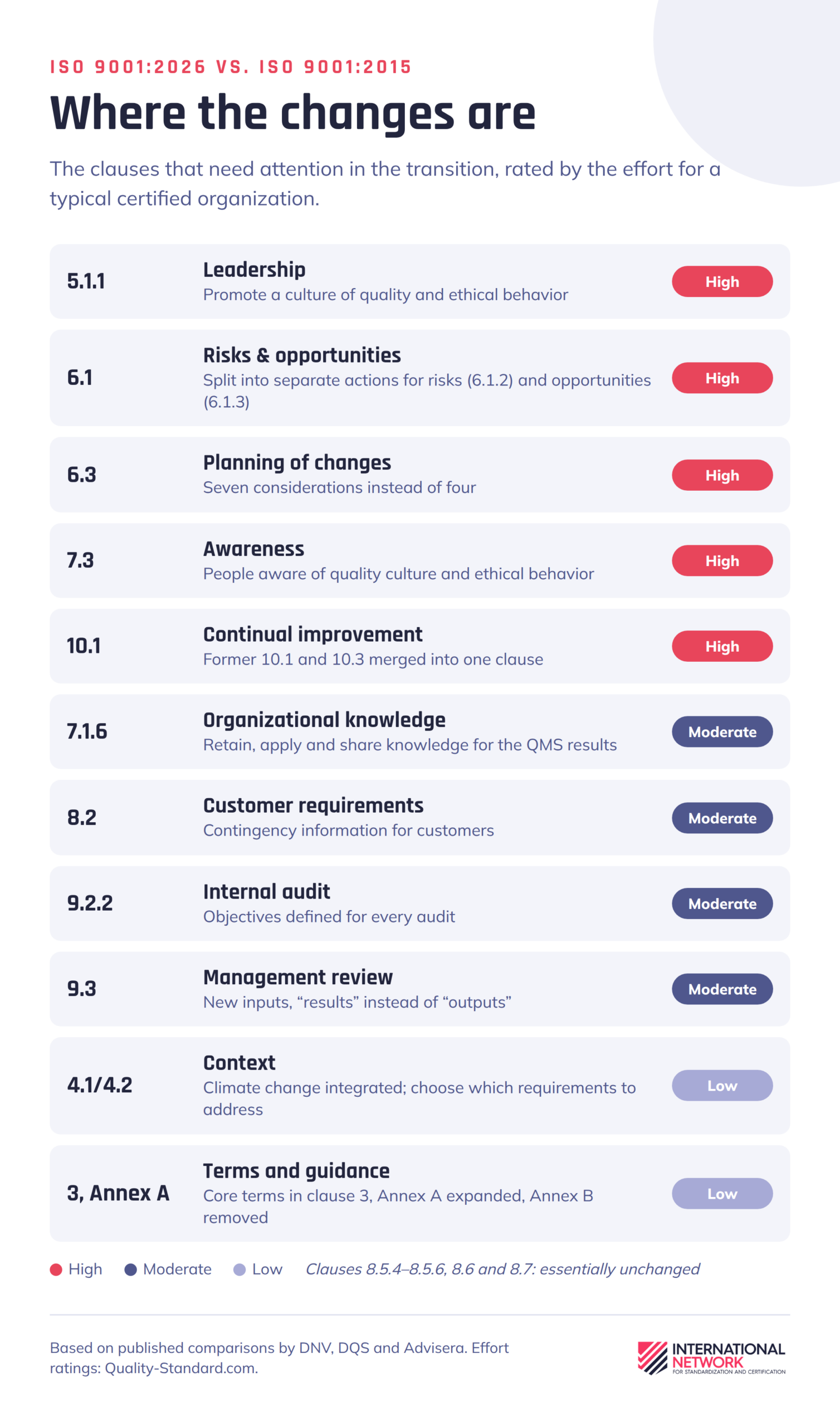
| Clause | ISO 9001:2015 | ISO 9001:2026 | Impact |
|---|---|---|---|
| 3 Terms and definitions | Refers to ISO 9000:2015 only | Lists the harmonized core terms, ISO 9000:2026 as normative reference | Low |
| 4.1 and 4.2 Context | Climate change added by Amendment 1:2024 | Climate provisions integrated; organization determines which requirements of interested parties the QMS will address | Low to moderate |
| 5.1.1 Leadership | Leadership and commitment | Top management must promote a culture of quality and ethical behavior | High |
| 6.1 Risks and opportunities | One clause for actions on risks and opportunities | Split into 6.1.1 general, 6.1.2 actions to address risks, 6.1.3 actions to address opportunities | High |
| 6.3 Planning of changes | Four considerations | Seven considerations, including monitoring, communication and review of changes | High |
| 7.1.6 Organizational knowledge | Knowledge for operation of processes and conformity | Knowledge for the intended results of the QMS; retained, applied and shared | Moderate |
| 7.3 Awareness | Policy, objectives, contribution, implications | Additionally quality culture and ethical behavior | High |
| 7.5 Documented information | Documented information to maintain and retain | Distinction between information needed to support activities and documented information as evidence | Low |
| 8.2 Requirements for products and services | Customer communication | Contingency information for customers, including on disruptions; updating of changed requirements | Moderate |
| 8.3 and 8.4 Design, external providers | Customers and users | Relevant interested parties included; design outputs cover safe and proper provision | Moderate |
| 8.5.1 Control of production | List of controlled conditions | Restructured into characteristics, activities and results | Moderate |
| 9.1.2 Customer satisfaction | Perception of customers | Simplified to monitoring customer satisfaction, with sources such as complaints and social media in a note | Moderate |
| 9.2.2 Internal audit | Criteria and scope | Audit objectives must also be defined for each audit | Moderate |
| 9.3 Management review | Inputs and outputs | New inputs on interested parties; “results” instead of “outputs” | Moderate |
| 10.1 Continual improvement | General (10.1) and continual improvement (10.3) | Merged into one clause on continual improvement | High |
| Annex B | Other ISO/TC 176 standards | Removed; references moved to Annex A and the committee website | None |
Clause 3: the vocabulary moves into the standard
ISO 9001:2015 referred readers to ISO 9000:2015 for all definitions. ISO 9001:2026 now lists the core terms of the harmonized structure directly in clause 3 and names ISO 9000:2026 as the normative reference for further terms. ISO 9000:2026 itself was published in May 2026 as the fifth edition of the fundamentals and vocabulary standard. For users, this mainly means fewer documents to consult. For trainers and auditors, it means that some definitions have been sharpened, for example around risks, opportunities and the process approach.
Clauses 4.1 and 4.2: climate and the requirements you choose to address
The climate change sentences of the 2024 amendment are now part of the text. The organization determines whether climate change is a relevant issue, and the note on climate-related requirements of interested parties remains. This does not mean that ISO 9001 now requires carbon targets. It asks whether climate-related issues, such as extreme weather affecting supply or customer requirements on emissions, can affect the ability to deliver conforming products and services.
Clause 4.2 contains a small but useful addition. The organization now determines which of the relevant requirements of interested parties will be addressed through the quality management system. Legal and regulatory requirements and the requirements a company has accepted from its customers cannot be dropped this way, but the clause makes it easier to explain why a wish of a stakeholder does not appear in the QMS.
Clause 5.1.1: quality culture and ethical behavior
This is the change that will be discussed most in audits. Top management must now actively promote a culture of quality and ethical behavior. The 2015 edition already expected leadership to take accountability and to promote the process approach and risk-based thinking, but culture and ethics were not named as requirements. In 2026 they are.
The standard does not prescribe how culture is measured, and auditors cannot certify an attitude. What they can check is whether management does something visible and consistent. Typical evidence includes how decisions are made when quality and delivery dates conflict, whether employees can report problems without fear, how the organization handles mistakes, whether there are rules on conflicts of interest and gifts, and whether managers raise quality topics in their regular meetings. Related changes appear in clause 7.3, where people must be aware of the quality culture and ethical behavior, and in a note to clause 7.1.4, which says that parts of the work environment can be influenced by them.
For many small and mid-sized companies, this requirement is a chance rather than a burden. Employee surveys, which some companies already run for employer branding, provide exactly the kind of evidence an auditor looks for: what employees say about leadership, about how mistakes are handled and about whether they would recommend their employer. Seals based on such surveys, such as the employer certifications of our partner institute USIQ in the United States, measure some of the same things from a different angle.
Clause 6.1: risks and opportunities are now separate
ISO 9001:2015 treated risks and opportunities in one sentence, and many organizations ended up with a risk register that had a column for opportunities which nobody filled in. ISO 9001:2026 splits the clause. 6.1.1 deals with determining risks and opportunities. 6.1.2 requires actions to address risks, and these actions must be proportionate to the potential effect on the intended results of the QMS. A note mentions risks to conforming output during and after a disruption, which links quality management with business continuity. 6.1.3 requires actions to address opportunities that fit the context of the organization and support the desired results.
| Risk (6.1.2) | Opportunity (6.1.3) | |
|---|---|---|
| Example | A single supplier delivers a critical component | A customer asks for a digital order status that competitors do not offer |
| Question | What happens to conforming output if the supplier fails? | Does the idea support our intended results and fit our context? |
| Proportionate action | Qualify a second source, define a safety stock | Pilot with two customers, measure response times and complaints |
| Evidence for the audit | Supplier evaluation, stock rules, test of the fallback | Decision record, pilot results, review in the management review |
Clause 9.1.3 and the management review in 9.3.2 follow the split: the effectiveness of actions on risks and the effectiveness of actions on opportunities are evaluated as two separate items.
Clause 6.3: planning of changes with seven considerations
Changes to the QMS are a typical source of nonconformities: a new ERP system, a reorganization, a new site. ISO 9001:2015 asked organizations to consider four things when planning such changes: the purpose of the change and its potential consequences, the integrity of the QMS, the availability of resources and the allocation of responsibilities. ISO 9001:2026 keeps these and adds three more: how the effectiveness of the change will be monitored and evaluated, how the change will be communicated, and how its results will be reviewed. Information is also named next to resources. In practice, a short change plan with an owner, a communication step and a review date after implementation covers the new requirement.
Clause 7: knowledge, awareness and documented information
The clause on organizational knowledge (7.1.6) no longer refers only to the knowledge needed to operate processes and achieve conformity of products and services. It now covers the knowledge needed to achieve the intended results of the QMS as a whole, and this knowledge must be retained, applied and shared as necessary, not only made available. Companies that rely on a few experienced employees should look at how their knowledge is passed on when someone retires or leaves.
Clause 7.5 now distinguishes between information that must be available to support activities and documented information that is kept as evidence. Existing documents do not need to be renamed. The change mainly clarifies what auditors may ask to see as a record.
Clause 8: customers, interested parties and contingencies
The operational clauses change in detail. Under 8.2.1, customers must receive relevant contingency information, for example on how the organization will respond to a disruption. A note lists possible communication channels. When requirements for products and services change, relevant documented information must be updated and the people concerned informed (8.2.4). In design and development, relevant interested parties are now considered alongside customers and users (8.3.2), and design outputs must include the information needed for the safe and proper provision of products and services (8.3.5). External providers must also know the requirements for their interactions with the organization’s customers and other relevant interested parties (8.4.3). Clause 8.5.1 on the control of production and service provision has been restructured into characteristics, activities and results, while the validation of processes whose output cannot be verified remains.
Clause 9: customer satisfaction, audits and management review
Clause 9.1.2 has been simplified to the monitoring of customer satisfaction, and a note lists sources such as complaints and social media. Each internal audit must now have defined objectives in addition to criteria and scope (9.2.2). An audit program that only lists dates and departments will need an extra line per audit. In the management review, changes in the needs and expectations of interested parties are an explicit input, and the review produces “results” rather than “outputs”, including decisions on improvement opportunities, on any need for changes to the QMS and on resources.
Clause 10: one clause for continual improvement
ISO 9001:2015 had a general clause on improvement (10.1), a clause on nonconformity and corrective action (10.2) and a short clause on continual improvement (10.3). In ISO 9001:2026, the first and the last are merged into a new clause 10.1, continual improvement. Monitoring and measurement results are explicitly named as inputs for finding improvement opportunities, and actions must consider future needs and expectations as well as correcting, preventing or reducing undesired effects. Annex A adds guidance on drivers of improvement such as changes in context, risks, opportunities and the adoption of new technology. Clause 10.2 on nonconformity and corrective action remains with editorial changes.
ISO 9000:2026 and the seven quality management principles
ISO 9001 is built on the quality management principles described in ISO 9000. The fifth edition, ISO 9000:2026, was published in May 2026 and keeps the seven principles introduced in 2015: customer focus, leadership, engagement of people, process approach, improvement, evidence-based decision making and relationship management. What changed are mainly the explanations and a number of definitions, which were adapted to the harmonized structure and to the wording of ISO 9001:2026. Our article on the seven quality management principles explains each of them with practical questions and evidence.
Transition rules: dates, audits and certificates
ISO publishes standards, but it does not decide how long certificates remain valid. That is the job of the international accreditation system. On 1 January 2026, the International Accreditation Forum (IAF) and the International Laboratory Accreditation Cooperation (ILAC) were replaced by Global Accreditation Cooperation Incorporated, known as Global ACI. Global ACI has set a three-year transition period for ISO 9001:2026, the same length as for previous revisions.
| Rule | What it means for you |
|---|---|
| Transition period of three years from 16 September 2026 | You can plan the transition into a regular surveillance or recertification audit |
| ISO 9001:2015 certificates expire on 30 September 2029 | A certificate that has not been transitioned by then loses its validity |
| From 31 March 2028, new initial certifications only to ISO 9001:2026 | Companies that are certified for the first time should plan directly for the 2026 edition |
| Certificates issued to ISO 9001:2015 during the transition | Their validity ends with the transition period, even if issued for three years |
| Certification bodies need accreditation for the new edition | In the first months after publication, transition audits are only available from bodies that are already accredited |
Two practical points are often overlooked. First, the usable time is shorter than three years, because certification bodies first need to train their auditors and be accredited for the new edition, and because audit capacity becomes scarce close to the deadline. Second, the transition is usually assessed during a regular audit, often with additional audit time. Ask your certification body three questions early: until when it will still issue initial certificates to the 2015 edition, at which of your scheduled audits it plans to assess the transition, and how much additional audit time it will charge.
A step-by-step transition plan
For an organization with a functioning ISO 9001:2015 system, the transition is a project of a few months, not years. The following plan has proven useful because it starts with the requirements that need the most thought and ends with evidence that the auditor can see.
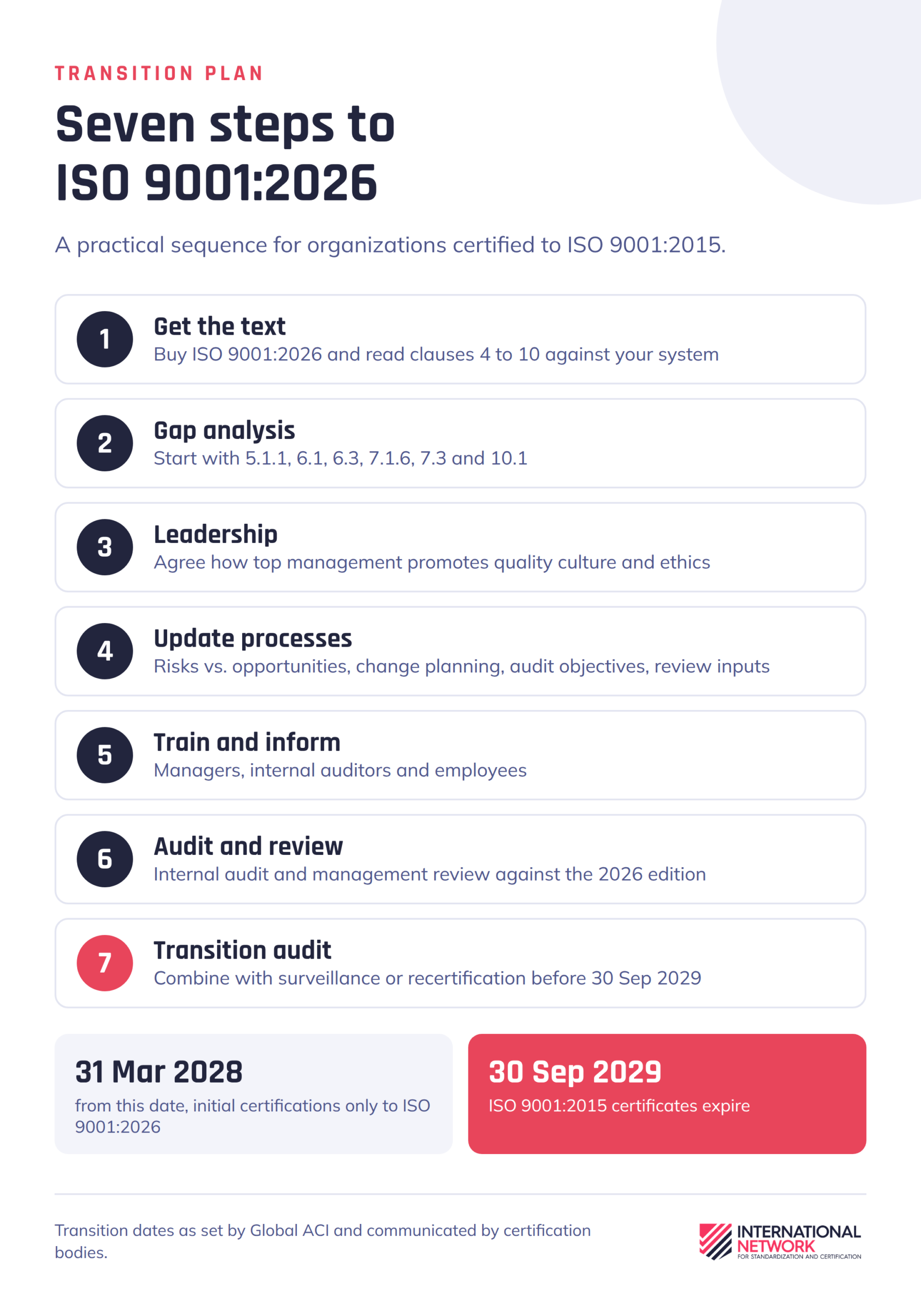
| Step | What to do | Evidence for the auditor |
|---|---|---|
| 1. Get the text | Buy ISO 9001:2026 from ISO or your national standards body and read clauses 4 to 10 against your current system | Current edition available to the people who need it |
| 2. Gap analysis | Compare each changed clause with your processes, starting with 5.1.1, 6.1, 6.3, 7.1.6, 7.3 and 10.1 | Gap list with owner and deadline |
| 3. Leadership | Agree with top management how quality culture and ethical behavior are promoted, for example through a code of conduct, a reporting channel and regular quality topics in management meetings | Management decisions, communication, minutes |
| 4. Update processes | Separate risk and opportunity actions, extend the change planning template, update knowledge management, audit objectives and the management review agenda | Revised procedures, templates and records |
| 5. Train and inform | Explain the changes to managers, internal auditors and employees; check awareness of quality culture | Training records, awareness checks |
| 6. Internal audit and management review | Audit against ISO 9001:2026 and hold a management review with the new inputs | Audit report, management review results |
| 7. Transition audit | Agree the date with your certification body and close any findings | Certificate to ISO 9001:2026 |
Gap analysis checklist for ISO 9001:2026
These questions help to find the gaps quickly. If the answer to a question is “no” or “not documented”, the corresponding clause needs work before the transition audit.
| Clause | Question | Yes / No |
|---|---|---|
| 4.1 | Have we decided and recorded whether climate change is a relevant issue for us? | |
| 4.2 | Have we decided which requirements of relevant interested parties our QMS addresses? | |
| 5.1.1 | Can top management show how it promotes a culture of quality and ethical behavior? | |
| 6.1.2 | Are our actions on risks proportionate to their possible effect, including disruptions? | |
| 6.1.3 | Do we have a separate, documented way to decide on opportunities? | |
| 6.3 | Does our change planning cover monitoring, communication and review of results? | |
| 7.1.6 | Is critical knowledge retained and shared, not only stored? | |
| 7.3 | Are employees aware of our quality culture and ethical principles? | |
| 8.2.1 | Do customers receive contingency information where relevant? | |
| 9.2.2 | Does every internal audit have defined objectives? | |
| 9.3.2 | Does the management review consider changes in interested party needs? | |
| 10.1 | Do we use monitoring and measurement results to identify improvement opportunities? |
Five myths about ISO 9001:2026
Myth 1: The 2015 certificate becomes invalid on the publication date. It does not. ISO 9001:2015 certificates remain valid until the end of the transition period on 30 September 2029.
Myth 2: ISO 9001:2026 contains requirements for artificial intelligence. The standard remains technology neutral. AI can be a context issue, a risk or an opportunity, but there is no AI clause.
Myth 3: Companies now need carbon targets. The climate requirement asks whether climate change is relevant to the quality management system. It does not require an environmental management system or emission targets; those are the subject of ISO 14001.
Myth 4: All documents must be renamed. The clarification in 7.5 does not require new names or new document structures. What matters is that the information needed and the evidence kept are clear.
Myth 5: Quality culture can be certified with a poster. Auditors look for consistent behavior and evidence, not slogans. A value statement on the wall without decisions, communication and employee involvement behind it will not satisfy clause 5.1.1.
What ISO 9001:2026 means for small and mid-sized companies
Large groups have quality departments that will absorb the revision as one project among many. For a company with 30 or 150 employees, the quality manager is often also responsible for health and safety, data protection or purchasing. For these organizations, three points matter most.
First, the transition does not have to be a separate project. Most of the new requirements can be built into routines that already exist: the management review gets two new inputs, the audit program gets one more column, the risk register gets a separate section for opportunities, and the change request form gets three more questions. An afternoon with the top management team on quality culture and ethics is usually the step that takes the most thought, not the most paperwork.
Second, the new requirements reward what good small companies already do. Owners who talk to their teams every week, who know their key customers personally and who discuss mistakes openly often have a stronger quality culture than large organizations with thick manuals. The task is to make this visible and repeatable, so that it still works when the company grows or the owner is on holiday.
Third, timing can save money. A company whose recertification audit falls in 2027 or 2028 can combine it with the transition and avoid an extra audit. A company that waits until 2029 competes with thousands of others for auditor days and risks a gap in its certification if findings cannot be closed in time. Planning the transition into the next regular audit is therefore usually the cheapest and safest option.
ISO 9001 in numbers
According to the ISO Survey 2024, more than 1.47 million ISO 9001 certificates were valid worldwide, far more than for any other management system standard. ISO 14001 followed with around 676,000 certificates. The survey is now compiled from the IAF CertSearch database of accredited certificates. Because the method of data collection has changed, comparisons with earlier years are of limited value. What the numbers show beyond doubt is the scale of the transition: every one of these certificates has to move to the 2026 edition or expire.
| Edition | Year | Main change |
|---|---|---|
| First | 1987 | Three models for quality assurance (ISO 9001, 9002, 9003) |
| Second | 1994 | Focus on preventive action instead of final inspection |
| Third | 2000 | One standard with the process approach; ISO 9002 and 9003 withdrawn |
| Fourth | 2008 | Clarifications, no new requirements |
| Fifth | 2015 | High level structure, risk-based thinking, context of the organization |
| Sixth | 2026 | Quality culture and ethics, separate risks and opportunities, planning of changes, harmonized structure |
ISO 9001 certification and quality seals: what each one proves
An ISO 9001 certificate shows that an organization has a management system that meets the requirements of the standard. It does not say how good the products are, how satisfied customers are or how employees experience their employer. This is not a weakness of ISO 9001; it is simply a different question. Our article on conformity assessment, certification and accreditation explains the difference between certifying a system and testing a result.
The new emphasis on culture and ethics brings the two worlds closer. An organization that has to show how it promotes a quality culture can use the results of employee and customer surveys as evidence. Seals based on such surveys measure results from the perspective of the people concerned, while ISO 9001 checks whether the system that produces those results is under control. Companies that want to know how to tell a meaningful seal from a marketing badge will find the criteria in our quality seal checklist, and an overview of the standards of our network on the quality standards page.
For a broader explanation of how certification bodies, accreditation bodies and Global ACI work together, read our guide to third-party certification.

Frequently asked questions about ISO 9001:2026
When was ISO 9001:2026 published?
ISO published ISO 9001:2026 on 16 September 2026. It is the sixth edition of the standard and replaces ISO 9001:2015 including Amendment 1:2024.
How long is the transition period for ISO 9001:2026?
Three years. ISO 9001:2015 certificates remain valid until 30 September 2029. From 31 March 2028, new initial accredited certifications are only issued to ISO 9001:2026.
Is ISO 9001:2026 a major revision?
No. The structure is unchanged and most requirements are the same. Certification bodies describe the extent of change as moderate. The main work concerns clauses 5.1.1, 6.1, 6.3, 7.1.6, 7.3 and 10.1.
Do we need a new quality manual for ISO 9001:2026?
No. ISO 9001:2026 does not require a quality manual. You need the documented information that your processes and the standard require, updated where the requirements have changed.
Can a company still be certified to ISO 9001:2015 for the first time?
Only before 31 March 2028, and such a certificate expires on 30 September 2029 at the latest. Many certification bodies stop earlier, so first-time applicants should plan for ISO 9001:2026 directly.
What is the difference between ISO 9000:2026 and ISO 9001:2026?
ISO 9000:2026 explains the fundamentals, the seven quality management principles and the vocabulary. ISO 9001:2026 contains the requirements against which organizations are certified.
Sources
- ISO: ISO 9001:2026, Quality management systems, Requirements
- ISO: ISO 9001:2026, What businesses need to know
- ISO: ISO 9000:2026, Quality management, Fundamentals and vocabulary
- DNV: ISO 9001:2026 standard revision and transition rules
- LRQA: ISO 9001 revision update, publication date confirmed
- LRQA: ISO 9001:2026 certification and transition timeline
- DQS: ISO 9001 revision 2026, overview of new requirements
- Advisera: ISO 9001:2015 vs. ISO 9001:2026, main differences
- ISO: How the ISO Survey of certifications is compiled
- SGS: ISO 9001 overview with ISO Survey 2024 figures