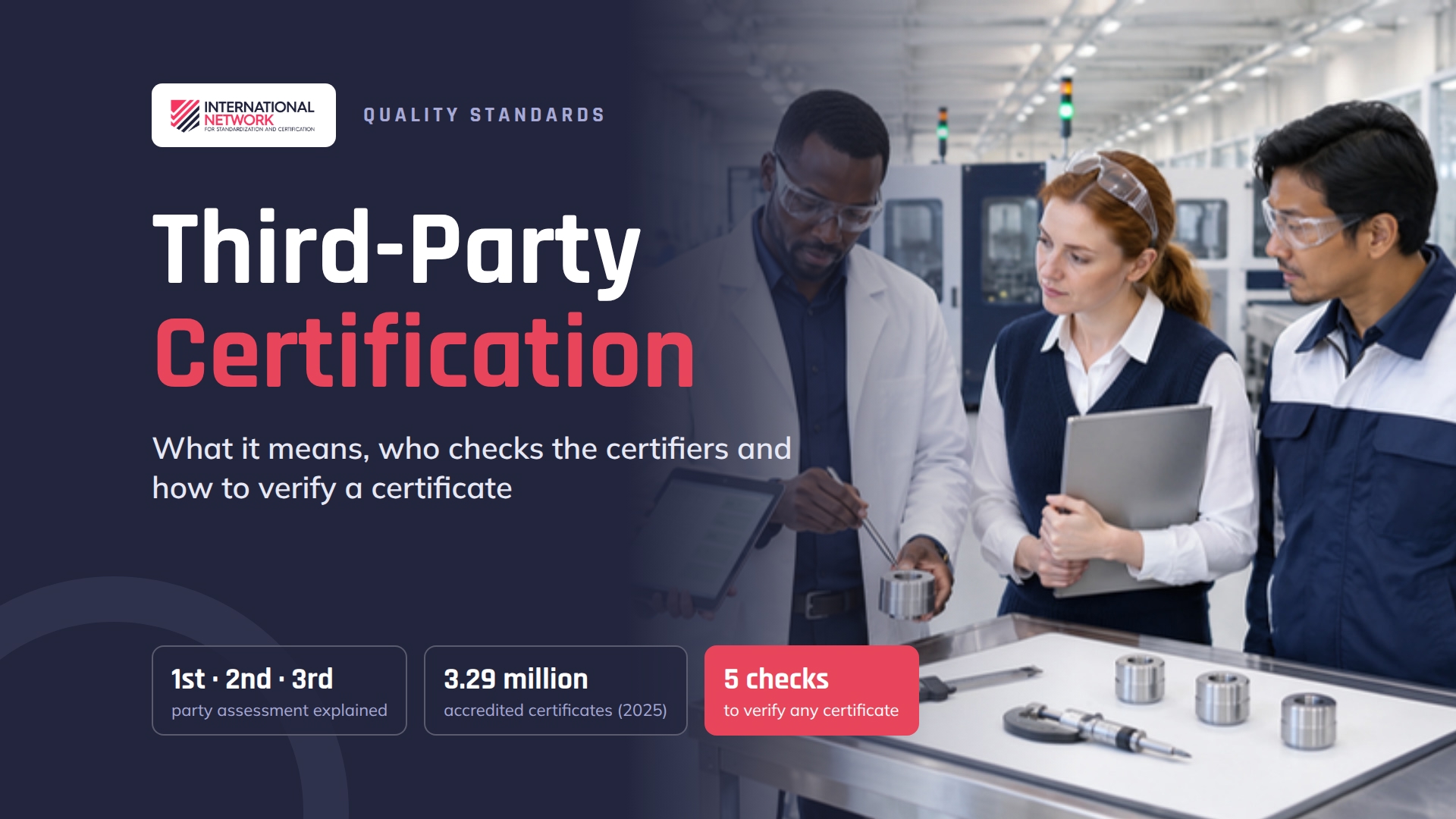
A label that says “certified” can mean almost anything. It can stand for years of audits by an accredited body, for a lab report on a single batch, or for a logo a company designed for itself. Third-party certification is the version that is supposed to carry real weight: someone who neither sells the product nor buys it checks it against published requirements and puts their name on the result.
Buyers, regulators and procurement teams lean on that idea every day. So do consumers, often without realizing it, whenever they pick a power strip with a safety mark or a coffee with an organic seal. This guide explains what third-party certification actually is, how it differs from self-declarations and customer audits, who checks the certifiers, what the process looks like, where US law requires it and how to tell in a few minutes whether a certificate deserves your trust.
In short: Third-party certification is a written assurance by an independent body that a product, process, service, management system or person meets specified requirements. “Independent” means independent of both the supplier and the customer. Its value depends on three things: the criteria behind it, the competence and impartiality of the certifier, and ongoing surveillance after the certificate is issued. Accreditation is the system that checks the certifiers themselves. Since 1 January 2026, its international arrangement is run by Global ACI, the successor of IAF and ILAC.
What is third-party certification?
The international vocabulary for this field is ISO/IEC 17000:2020, Conformity assessment, Vocabulary and general principles. It describes conformity assessment as demonstrating that specified requirements for a product, process, system, person or body are fulfilled. Testing, inspection, certification and accreditation are all forms of it. Certification is the step in which a body issues a statement, usually a certificate and often a mark, that conformity has been demonstrated.
The standard sorts these activities by who performs them. A third-party activity is carried out by a person or body that is independent of the organization providing the object and of the users of that object. That second half is easy to overlook. An audit commissioned and controlled by a large retailer is not third-party, even if an outside firm does the work, because the retailer has a user interest. The definitions are about interests, not about whose employees show up.
Two further points matter in practice. First, a certificate always has a scope: specific products, sites, services or a defined management system, measured against a named standard or set of criteria. A certificate for one plant says nothing about the plant next door. Second, certification is not a one-time event. Serious schemes keep watching after the certificate is issued, through surveillance audits, market sampling or periodic retesting. Without that, a certificate only tells you what was true on the audit day.
First-party, second-party and third-party assessment compared
ISO/IEC 17000 distinguishes three kinds of conformity assessment. All three are legitimate and widely used. They simply answer the question “who says so?” in different ways, which is why they carry different weight with a skeptical buyer.
| First-party | Second-party | Third-party | |
|---|---|---|---|
| Performed by | The supplier itself, or a consultant working on its behalf | A customer, purchaser or an organization representing user interests | A body independent of both the supplier and the users |
| Typical examples | Supplier’s declaration of conformity, internal audit, self-declared label | Supplier audit by an automaker, retailer factory audit, government procurement audit | Accredited ISO 9001 certification, product safety listing, organic certification |
| Main strength | Fast and cheap; the supplier knows its process best | Tailored to the exact needs of one customer | Impartial result that many customers can rely on at once |
| Main weakness | Obvious conflict of interest | Repeated audits for every customer; results rarely shared | Costs money and time; quality depends on the certifier |
| Who relies on it | Mostly the supplier and low-risk markets | The commissioning customer | Customers, regulators and the public |
Most companies use all three. A manufacturer runs internal audits (first party), hosts audits from key customers (second party) and holds certificates from independent bodies (third party). The point of the third-party layer is efficiency as much as trust: one independent audit can replace dozens of customer audits, provided the customers accept the certifier.
Third-party tested vs. third-party certified
The two phrases are often used as if they meant the same thing, especially on consumer products. They do not. A test is a snapshot; a certification is a commitment that continues.
| Aspect | Third-party tested | Third-party certified |
|---|---|---|
| What happens | An independent lab tests one or more samples against stated methods | An independent body evaluates the product or system, decides on conformity and grants the right to use a certificate or mark |
| Output | Test report or certificate of analysis | Certificate, listing or mark with a defined scope and validity |
| Coverage over time | The tested sample or batch only | Ongoing, through surveillance audits, factory inspections or periodic retesting |
| Governing standard for the body | ISO/IEC 17025 for testing laboratories | ISO/IEC 17065 (products, processes, services), ISO/IEC 17021-1 (management systems), ISO/IEC 17024 (persons) |
| Question to ask | Which lab, which tests, which batch? | Which certifier, which scope, is it still valid? |
“Tested” claims are not worthless. A report from an accredited lab is solid evidence about the sample it covers. The risk is in what gets implied: a single passed test on a pre-production sample can end up on packaging for years of production runs. When a product claims to be “certified”, you should be able to find the certifier, the scope and the expiry date.
Four kinds of third-party certification
“Certification” covers very different objects. Mixing them up is the most common reason people overestimate what a certificate says. The international standards for certifiers draw the lines quite clearly, and it helps to know which family a certificate belongs to before judging it.
| Kind | What is certified | Rules for the certifier | Typical examples |
|---|---|---|---|
| Product, process and service certification | Specific products, product families, processes or services against a product standard or scheme | ISO/IEC 17065 | Safety listings for electrical equipment, Energy Star, organic food, many food safety schemes |
| Management system certification | How an organization plans, runs, checks and improves its work in a defined scope | ISO/IEC 17021-1 | ISO 9001, ISO 14001, ISO 45001, ISO/IEC 27001 |
| Certification of persons | The competence of an individual, usually through an exam and recertification | ISO/IEC 17024 | Certified auditors, welders, inspectors, project managers |
| Seals based on surveys and assessments | How customers or employees experience a company, combined with an assessment of policies and practices | Scheme rules; often not accredited | Employer seals, service quality seals, customer satisfaction awards |
Each kind answers its own question. A product listing tells you that the listed model met a safety standard when it was tested and that the factory is still being watched. A management system certificate tells you that the organization runs its processes in a controlled way. A person certificate says something about one individual, not about the employer. And a survey-based seal tells you how the people affected rate the company. None of them can stand in for another, which is why serious buyers often ask for more than one.
A practical consequence: a company that holds an ISO 9001 certificate may not print the certification mark on a product as if the product itself had been certified. Certifiers write this into their rules for using marks, and accreditation bodies check it. If you see a management system logo on a product label, read it as “made by a company with a certified system”, nothing more.
Who checks the certifiers? Accreditation and Global ACI
Anyone can call themselves a certification body. Accreditation is how the market separates competent certifiers from the rest. An accreditation body assesses certification bodies, labs and inspection bodies against the international standards that apply to them, checks their impartiality and competence, and keeps watching them. In the United States, accreditation bodies include ANAB (the ANSI National Accreditation Board), A2LA and IAS.
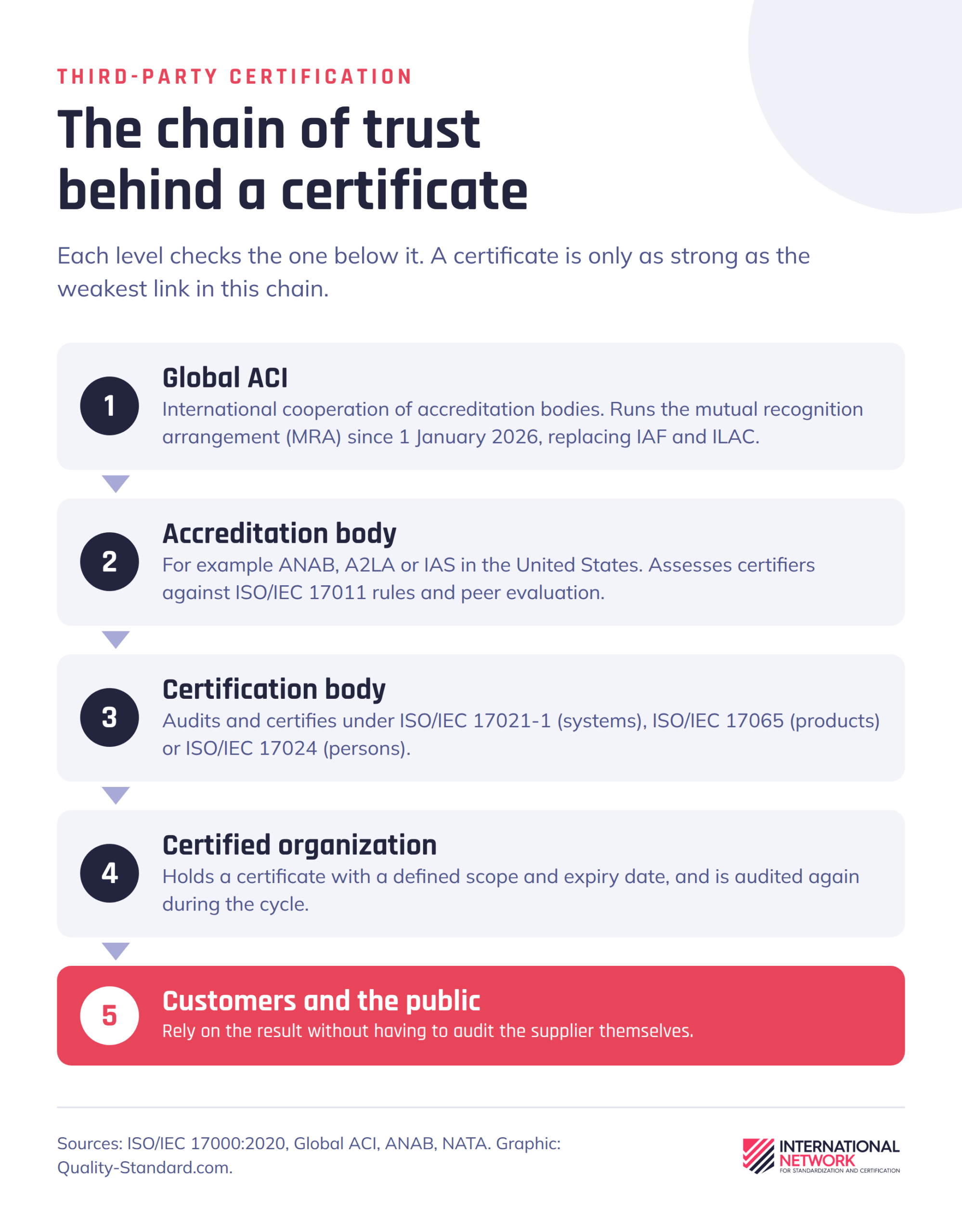
Accreditation bodies in turn are evaluated by their peers. Until the end of 2025, two international organizations managed these arrangements: the International Accreditation Forum (IAF) for certification bodies and the International Laboratory Accreditation Cooperation (ILAC) for labs and inspection bodies. On 1 January 2026, both were replaced by a single organization, the Global Accreditation Cooperation Incorporated, known as Global ACI. Its Multilateral Recognition Arrangement (MRA) took over the scopes of the former IAF MLA and ILAC MRA, and recognition of existing accredited results continues without interruption during the transition.
The practical effect for buyers is the “certify once, accepted everywhere” principle. A certificate issued by a certifier that is accredited by a signatory of the arrangement, for the relevant scope, should be accepted by other signatories without a new audit. That is why procurement specifications often ask not just for a certificate but for an accredited one.
Governments lean on the same logic in trade policy. Article 6 of the WTO Agreement on Technical Barriers to Trade asks member countries to accept the results of conformity assessment carried out in other member countries, even where procedures differ, as long as they offer equivalent assurance, and it encourages mutual recognition agreements. Accreditation under internationally recognized standards is one of the main tools regulators use to decide whether a foreign test report or certificate can be trusted. For exporters, that turns a well-chosen certificate into a door opener rather than another piece of paperwork.
Accreditation is not the only route to credibility, and it is not legally required for every kind of certificate. Many private labels, employer seals and service awards are not accredited. That does not make them worthless, but it shifts the burden: the scheme then has to earn trust through published criteria, a transparent method, clear limits and a way to verify each result. Our overview of conformity assessment, certification and accreditation goes deeper into these terms.
Why independence matters: the Energy Star test
The clearest case for third-party certification in the United States comes from an undercover investigation. In 2009 and 2010, the Government Accountability Office (GAO) set up four fictitious manufacturers and submitted 20 made-up products for the federal Energy Star label. The report, published in March 2010, found that the program was largely a self-certification scheme. Fifteen of the bogus products were certified, including a gasoline-powered alarm clock and an “air cleaner” that was a space heater with a feather duster and fly strips attached. Energy Star required independent verification for only 4 of the 20 submissions.
The fallout was quick. EPA and the Department of Energy stopped the automated approvals within weeks and reworked the program around testing by independent laboratories. Under the new rules that started in January 2011, products had to be tested by EPA-recognized labs and certified by recognized certification bodies before they could carry the label.
The lesson is not that manufacturers lie. Most do not. The lesson is that a label backed only by the seller’s own data cannot tell the honest manufacturer from the dishonest one, and therefore protects neither. Independent verification is what makes the honest claim believable.
Where US law requires third-party certification
In the US, most certification is voluntary and driven by customers. Some areas, however, make independent testing or certification mandatory or build it into federal rules. A few examples that affect a large number of businesses:
| Area | Rule | What it requires |
|---|---|---|
| Workplace equipment | OSHA, 29 CFR 1910.7 (NRTL Program) | Many types of electrical and other equipment used in workplaces must be tested and certified by a Nationally Recognized Testing Laboratory (NRTL) recognized by OSHA |
| Children’s products | Consumer Product Safety Improvement Act of 2008, 16 CFR part 1110 | Nearly all children’s products need a Children’s Product Certificate based on tests by a CPSC-accepted third-party lab; CPSC has accepted more than 600 labs worldwide |
| Energy Star | EPA and DOE program rules since 2011 | Products must be tested by EPA-recognized labs and certified by EPA-recognized certification bodies |
| Marketing claims | FTC Green Guides, 16 CFR 260.6 | Misrepresenting that a product or service has been endorsed or certified by an independent third party is deceptive |
The FTC rule deserves a closer look because it applies to every marketer, not just regulated products. Under 16 CFR 260.6, a seal or certifier’s name used in advertising may count as an endorsement. If a company awards a seal to its own product and nobody independent evaluated it, presenting that seal as if it came from a third party is deceptive. Third-party certification also does not relieve a marketer of the duty to substantiate every claim the seal conveys. And material connections between the marketer and the certifier should be disclosed; paying a reasonable certification fee alone usually does not count as such a connection, because people expect certifications to be paid for.
How third-party certification works, step by step
The details differ between schemes, but accredited certification follows a recognizable pattern. For management systems such as ISO 9001, the process is defined in ISO/IEC 17021-1. Product certification under ISO/IEC 17065 works similarly, with product testing and factory surveillance in place of system audits.
- Application and scope. The organization and the certifier agree on the standard, the sites, products or processes covered, and any outsourced activities. The certifier checks for conflicts of interest, for example whether it has recently provided consulting to the client.
- Stage 1 audit or document review. A readiness check: is the system documented, are internal audits and management reviews running, is the organization ready for the main audit?
- Stage 2 audit or evaluation. The main assessment on site, through interviews, records and observation. Nonconformities are recorded and must be corrected.
- Certification decision. Taken by people who were not part of the audit team. This separation is a basic safeguard against auditors becoming too close to the client.
- Certificate and mark. The certificate names the scope, the standard, the issue date and the expiry or recertification date. Use of marks is governed by rules; a management system mark, for instance, may not be printed on a product as if it certified the product.
- Surveillance. At least one audit per year. The first surveillance audit must take place within 12 months of the certification decision.
- Recertification. Before the end of the three-year cycle, a full audit decides whether the certificate is renewed for another cycle.
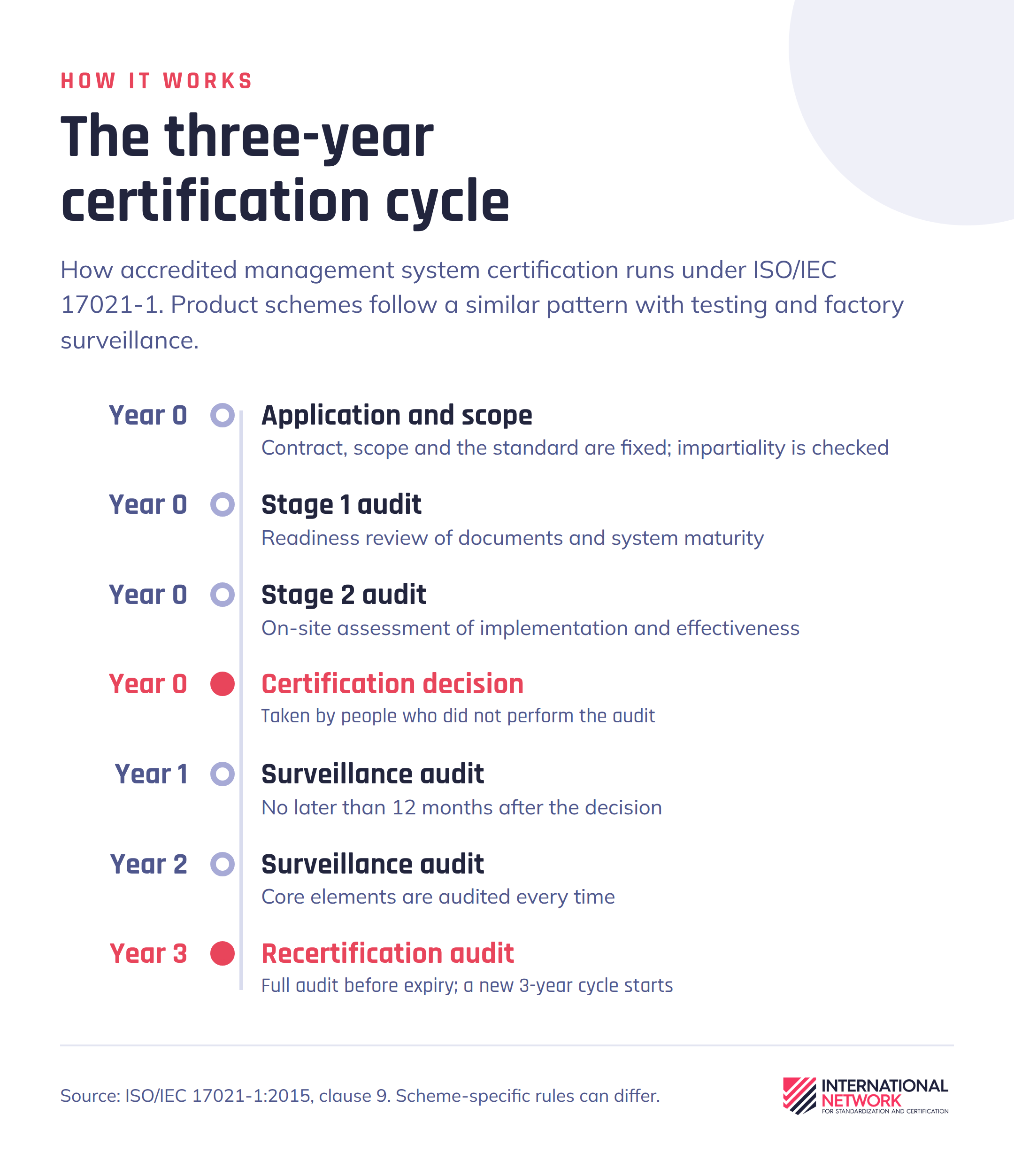
Two features of this process do most of the work. The separation of auditing and deciding keeps the result independent of individual relationships. Surveillance keeps it current. When either is missing, a certificate quickly becomes decoration.
What drives the effort and cost of certification
Certification bodies do not invent audit time freely, at least not in accredited management system certification. For quality, environmental and health and safety systems, the starting point is set by IAF mandatory document MD 5. It ties the number of audit days to the effective number of personnel in the scope, which counts permanent, temporary and part-time staff as well as people on every shift. From that starting point the certifier adjusts up or down for factors such as the complexity of processes, the number of sites, the level of risk or a very simple, repetitive operation. The justification has to be documented and can be reviewed by the accreditation body.
For a company budgeting a certification project, the cost picture usually breaks down like this:
- Audit days for the initial certification, the annual surveillance audits and the recertification. They make up the core of the certifier’s fee.
- Travel and site visits, which grow with every additional location in the scope.
- Testing in product schemes, often charged per model or product family, plus retesting during surveillance.
- Internal time for preparation, documentation, internal audits and management reviews. In smaller companies this is often the largest item and the one most often forgotten.
- Corrective actions when the audit finds nonconformities, from a quick fix to new equipment or training.
- Use of marks and listings, which some schemes charge separately.
Two pieces of advice save money. Ask for a written quote that states the number of audit days and how they were calculated; accreditation rules expect certifiers to be able to explain this. And be wary of offers that come in far below everyone else. An audit that is too short cannot cover the scope, and a certificate that later turns out to be weak costs more than the savings.
How to choose a certification body
For many standards, dozens of certifiers compete for the same customers. The cheapest is rarely the best choice, and the biggest is not automatically the right one either. These criteria help:
- Accreditation with the right scope. Check the accreditation body’s directory, not just the certifier’s brochure. The scope should cover your standard and your industry sector.
- Acceptance by your customers. Some customers and regulators accept only certain certifiers or schemes. Ask before you sign.
- Auditor competence in your sector. An auditor who knows your industry asks better questions and finds the issues that matter.
- Impartiality. A certifier may not consult on the system it certifies. Offers that bundle “implementation support” with certification from the same body are a warning sign.
- Transparent pricing. Audit days, travel, certificates and surveillance should be clear for the whole three-year cycle.
- Public verification. Your customers should be able to confirm your certificate in a register without asking you for a PDF.
Changing certifiers is possible. For accredited management system certificates, transfers between accredited bodies follow fixed rules, so a company is not locked in for life if the relationship does not work.
Third-party certification in numbers
The best data on how widespread certification is comes from the ISO Survey. Since the 2025 edition, ISO compiles it from anonymized, aggregated data in IAF CertSearch, the global database of accredited management system certificates. According to the ISO Survey 2025, published in autumn 2026, there were 3,287,917 valid accredited certificates worldwide across the surveyed standards, 11 percent more than a year earlier.
| Standard | Topic | Certificates 2024 | Certificates 2025 | Change |
|---|---|---|---|---|
| ISO 9001 | Quality management | 1,474,118 | 1,611,729 | +9.3% |
| ISO 14001 | Environmental management | 676,232 | 739,390 | +9.3% |
| ISO 45001 | Occupational health and safety | 542,527 | 599,532 | +10.5% |
| ISO/IEC 27001 | Information security | 96,709 | 125,622 | +29.9% |
| All surveyed standards | 2,962,170 | 3,287,917 | +11.0% |
Two caveats apply. The survey counts accredited management system certificates only, so product certifications, testing marks and private seals are not included. And because ISO changed its data source to IAF CertSearch, figures before 2024 are not directly comparable. The direction is still clear: the fastest growth is in information security, where customers increasingly demand independent proof before they share data with a supplier.
On the demand side, research consistently finds that independent labels change behavior, though the size of the effect depends heavily on the product. A 2021 systematic review and meta-analysis of 35 discrete choice experiments with 35,725 participants found that consumers were willing to pay a premium of 3.79 PPP dollars per kilogram for food with environmental labels, with the highest premiums for organic labels. Such figures cannot simply be transferred to other markets, but they show that a credible label has a measurable value.
Benefits and limits of third-party certification
| Benefits | Limits |
|---|---|
| Independent evidence that buyers and regulators can rely on without auditing you themselves | A certificate covers its scope and criteria, not everything a company does |
| Fewer repeated customer audits when one accepted certificate replaces many | Costs for audits, testing, corrective actions and internal time |
| Access to markets, tenders and supply chains that require certification | Quality depends on the certifier; weak or captured certifiers exist |
| A structured outside view that finds weaknesses before customers do | Audits are samples; they can miss problems between visits |
| A credible message in marketing, with legal protection when claims are accurate | Too many labels can confuse buyers and dilute trust in all of them |
The limits are worth taking seriously, because they are where certificates get misused. A management system certificate says the system is under control and built on the seven quality management principles; it does not grade the products. A product listing covers the listed models, not the whole catalog. Organizations that keep these boundaries clear in their own communication protect the value of their certificate.
How to verify a third-party certificate in five checks
Whether you are qualifying a supplier, checking a competitor’s claim or deciding which product to buy, five questions sort most certificates quickly.
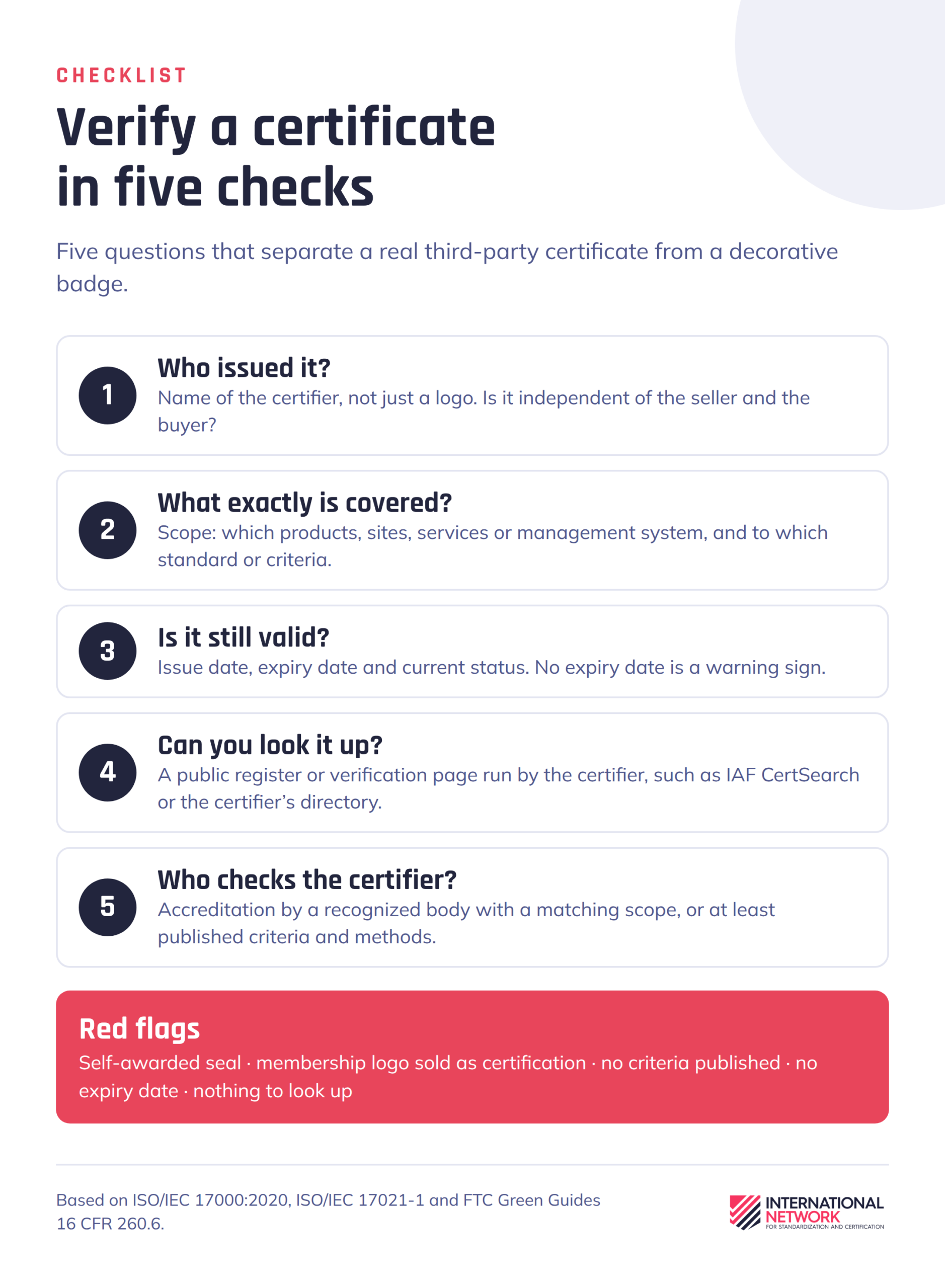
| Check | What to look for | Where to find it |
|---|---|---|
| 1. Issuer | The certifier is named and independent of the seller and the buyer | Certificate, label, product page |
| 2. Scope | Products, sites, services or system covered, and the standard or criteria used | Certificate text, certifier register |
| 3. Validity | Issue date, expiry date and current status (valid, suspended, withdrawn) | Certifier register or verification page |
| 4. Verifiability | A public record you can look up yourself, not just a PDF from the seller | IAF CertSearch for accredited management system certificates; certifier directories for products |
| 5. Oversight | Accreditation with a matching scope, or published criteria, methods and limits | Accreditation body directories (for example ANAB, A2LA, IAS); scheme website |
Typical red flags are a seal the company awarded to itself, an association membership logo presented as certification, criteria that are nowhere to be found, a certificate without an expiry date and a “verification” that only leads back to the seller’s own website. For seals and labels in particular, our checklist for credible quality seals lists further criteria.
Third-party seals for employers and service providers
Not every question a customer or job applicant asks is about a product or a management system. How satisfied are a company’s customers? How do employees rate their employer? Is the workplace really family friendly? Our guides to service quality standards and family-friendly workplace standards cover what good answers look like. Such questions are answered by asking the people concerned, not by auditing documents.
The United States Institute for Quality (USIQ) works this way. For its Top Employer, Family Friendly Employer and Top Service seals, USIQ combines a survey of employees or of the company’s own customers with an HR or management assessment against published criteria. Results are awarded in four tiers (Certified, Silver, Gold and Platinum), seals are valid for 24 months from the issue date, and each seal links to a public verification record with the organization, scope, tier, dates and status. If participation falls below the published minimum, no result is issued. USIQ states openly that a seal is not a government approval, not an accreditation and not an ISO 9001 certificate. The Top Employer methodology is published on its website.
Partner institutes in Europe use a similar approach with an extra layer of separation. In Germany, the Deutsches Institut für Qualitätsstandards und -prüfung e. V. (DIQP) works with a four-pillar model that keeps the seal provider, the company, the consultant who runs the survey and the external certification company apart; the certifier confirms eligibility before DIQP awards a seal such as Top Arbeitgeber or Familienfreundlicher Arbeitgeber. Its Austrian division, ÖIQP, applies the same method and publishes the score thresholds for each rating in its overview of seals.
For transparency: Quality-Standard.com and USIQ are both operated by Quality Standardization and Certification LLC. We therefore describe USIQ’s method here rather than rate it, and encourage readers to apply the same five checks to its seals as to any other. The standards of our network and partner institutes are listed on the quality standards page.
Survey-based seals and accredited certificates do not compete. They answer different questions. An ISO 9001 certificate shows that the processes behind products and services are controlled; the new edition, explained in our guide to ISO 9001:2026, even asks top management to promote a culture of quality. Feedback from employees and customers shows how that culture is experienced. Together they give a fuller picture than either one alone.
Five common misconceptions
“Certified means the product is the best.” Certification confirms that requirements are met. It does not rank products against each other. Two certified products can differ a lot in quality, price and service.
“A certificate is valid forever.” Every serious certificate has an expiry date or a recertification date and can be suspended or withdrawn in between. Always check the current status, not just the PDF.
“The government approved it.” Most certification in the US is private and voluntary. Even where law requires third-party testing, the work is done by private labs and certifiers recognized by an agency, not by the agency itself.
“Accredited and certified are the same.” The supplier is certified; the certifier is accredited. A certificate from a non-accredited body can still be honest, but you lose the independent check on the certifier.
“If it says third-party, it is independent.” Only if the body is independent of both the seller and the buyer. A seal sold by an industry association to its own members, or an audit firm paid and directed by a single customer, does not meet that test.

Frequently asked questions about third-party certification
What does third-party certification mean?
It means an organization that is independent of both the supplier and its customers has checked a product, service, process, management system or person against defined requirements and confirmed in writing that they are met. Credible schemes continue to monitor the result after the certificate is issued.
What is the difference between first-, second- and third-party certification?
First-party assessment is done by the supplier itself, second-party assessment by a customer or someone representing user interests, and third-party assessment by a body independent of both. Strictly speaking, only the third-party form is called certification under ISO/IEC 17000.
Is third-party certification the same as accreditation?
No. Certification is about the supplier’s product, system or staff. Accreditation is about the certifier: an accreditation body confirms that a certification body, lab or inspection body is competent and impartial for a defined scope.
How long is a third-party certificate valid?
It depends on the scheme. Accredited management system certificates usually run on a three-year cycle with at least annual surveillance audits. Product certifications often remain valid as long as surveillance and retesting are passed. USIQ seals, for example, are valid for 24 months.
How can I check whether a certificate is genuine?
Look up the certificate in the certifier’s public register or in IAF CertSearch for accredited management system certificates. Compare the company name, scope, standard and expiry date with what the seller claims, and check that the certifier is accredited for that scope where accreditation applies.
Is third-party certification required by law in the US?
Mostly it is voluntary, but there are important exceptions. OSHA requires NRTL certification for many types of workplace equipment, the CPSC requires third-party testing by accepted labs for nearly all children’s products, and the FTC treats false claims of independent certification as deceptive.
Sources
- NIST: Conformity assessment, definitions from ISO/IEC 17000
- NIST: Third-party conformity assessment activity (ISO/IEC 17000:2020)
- GAO-10-470: Covert testing shows the Energy Star program certification process is vulnerable to fraud and abuse (2010)
- eCFR: 16 CFR 260.6, Certifications and seals of approval
- OSHA: Nationally Recognized Testing Laboratory Program
- CPSC: Third party testing for children’s products
- NATA: Communication to regulators about Global ACI (April 2026)
- ANAB: The transition to Global ACI
- DQS: ISO Survey 2025 figures (October 2026, Spanish)
- ISO: The ISO Survey and IAF CertSearch
- Meta-analysis: willingness to pay for ecolabelled foods (2021)
- ANAB: What are the IAF mandatory documents MD 1, 5 and 11?
- WTO: Agreement on Technical Barriers to Trade