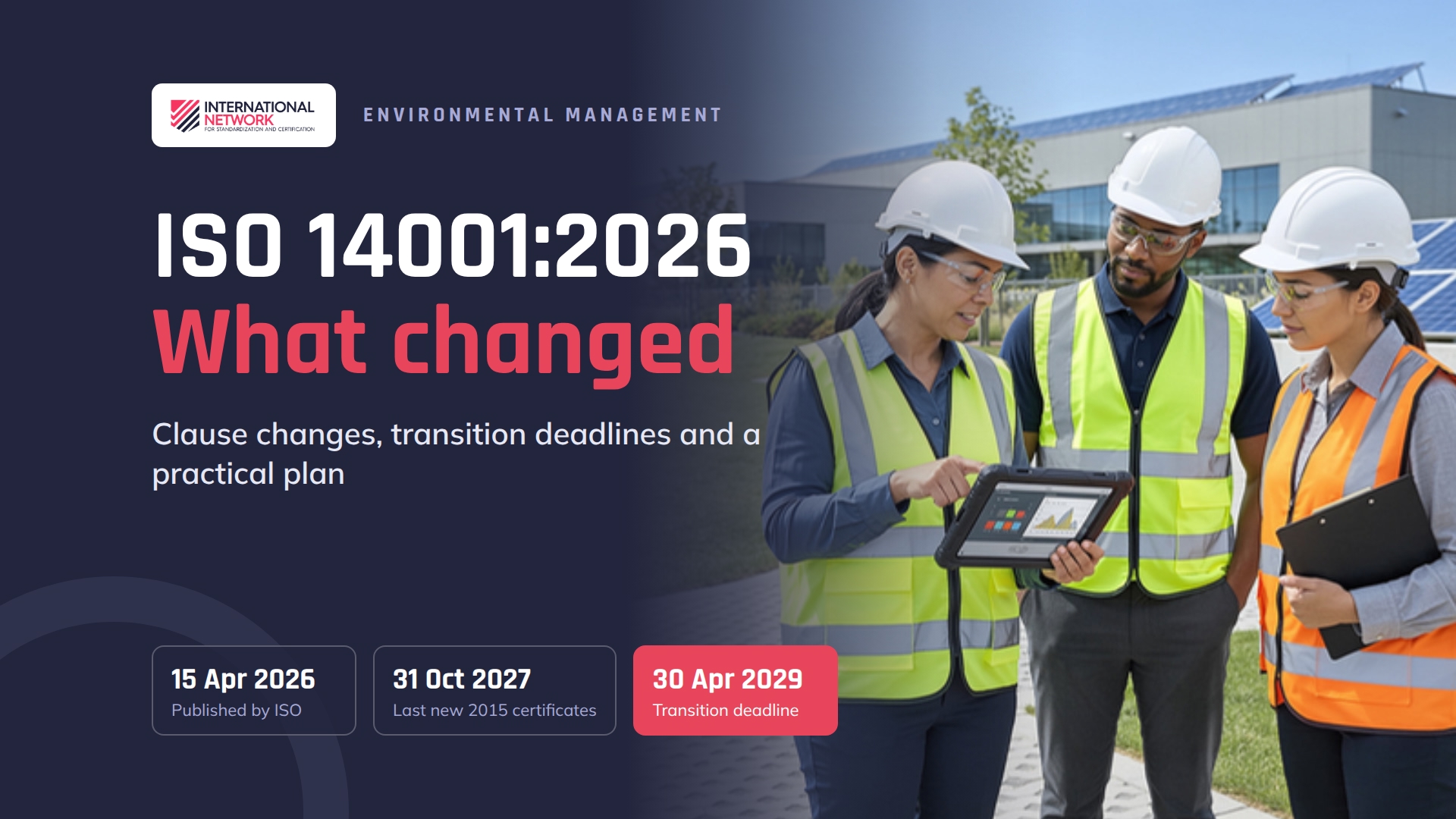
ISO 14001:2026 is the new edition of the world’s most widely used standard for environmental management systems. ISO published it on 15 April 2026, and it replaces ISO 14001:2015 together with the 2024 climate change amendment. If your company holds an ISO 14001 certificate, or a customer has asked you to get one, the new edition affects you, and the clock on the transition is already running.
The good news first. ISO itself calls this a targeted revision that builds on the existing structure. Nobody has to tear up a working system. The less comfortable news is that several changes reach into daily practice: how you look at your environmental context, how you plan changes, how you control suppliers and outsourced work, and how you run internal audits and management reviews.
This guide explains what changed, clause by clause, which dates matter for certified companies in the United States, and how a small or mid-sized company can plan the transition without wasting a year. All dates and figures come from ISO, the Global Accreditation Cooperation (Global ACI), accreditation bodies, certification bodies’ official notices and peer-reviewed research.
In short: ISO 14001:2026 (fourth edition, 36 pages) was published on 15 April 2026. It broadens the environmental conditions a company must consider (climate change, biodiversity, pollution, resources), adds a clause on planning changes (6.3), splits risk planning into 6.1.4 and 6.1.5, replaces “outsourced processes” with “externally provided processes, products and services,” and asks for audit objectives and a more structured management review. Under Global ACI rules, no new ISO 14001:2015 certificates may be issued after 31 October 2027, and all 2015 certificates lose validity on 30 April 2029.
ISO 14001:2026 at a glance
Here are the basic facts from ISO’s own standard page and the Global ACI transition document:
| Item | ISO 14001:2026 |
|---|---|
| Full title | Environmental management systems: Requirements with guidance for use |
| Edition | 4th edition, 36 pages |
| Published | 15 April 2026 |
| Developed by | ISO/TC 207/SC 1, Environmental management systems |
| Replaces | ISO 14001:2015 and ISO 14001:2015/Amd 1:2024 (both withdrawn) |
| Transition period | Three years, ending 30 April 2029 |
| Last new certificates to the 2015 edition | 31 October 2027 |
| Certificates worldwide | More than 670,000 certified organizations (ISO Survey 2024) |
The standard went through an unusually fast final stage. According to the ISO standard page, the final draft was registered in November 2025, the ballot ran from January to March 2026, and publication followed in April. The certificate count comes from ISO’s announcement of the new edition, which cites the ISO Survey 2024.
Why ISO revised ISO 14001
ISO 14001 was last fully revised in 2015. A decade later, three pressures had built up.
Climate change. In February 2024 ISO amended all its major management system standards, including ISO 14001, with two short climate additions. A joint ISO and IAF communiqué dated 22 February 2024 set out the wording. Clause 4.1 gained the sentence “The organization shall determine whether climate change is a relevant issue.” Clause 4.2 gained a note that relevant interested parties can have requirements related to climate change. The amendment was published on 23 February 2024 and is now folded into the 2026 edition.
Alignment with other standards. ISO wanted closer alignment with the harmonized structure that all its management system standards share. ISO 9001:2026 followed in September 2026, and ISO’s page for ISO 9001:2026 notes that ISO 9001 and ISO 14001 share a common structure, which makes integration easier.
A wider view of the environment. The new edition asks companies to look beyond emissions and waste, toward biodiversity, ecosystems and the availability of natural resources.
ISO’s Secretary-General Sergio Mujica summed up the intent in the launch announcement, describing the new edition as “smoother to implement” and well integrated with other ISO management system standards. ISO’s own explainer on what has changed puts it more plainly: the transition is about strengthening, not rebuilding.
What changed in ISO 14001:2026, clause by clause
ISO’s explainer lists the main changes at a high level. Certification bodies that sat on the committees have published more detail, notably SGS, and the U.S. accreditation body ANAB has published a summary of key changes. The table below combines these sources. Always check the wording against your own copy of the standard before you rewrite procedures.
Side-by-side comparison of the clauses
| Clause | ISO 14001:2015 | ISO 14001:2026 | What to do |
|---|---|---|---|
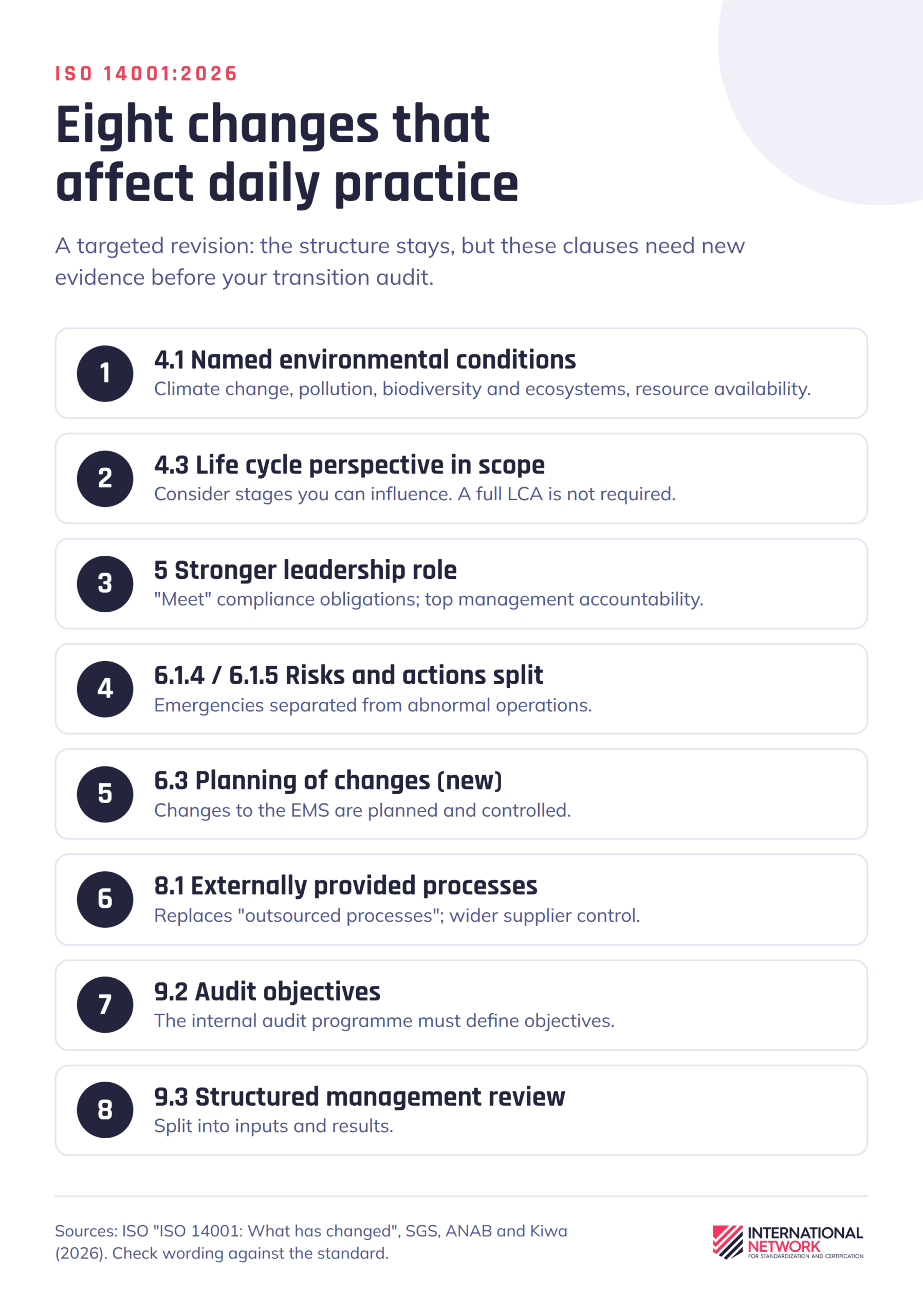
| 4.1 Context | Environmental conditions in general; climate sentence added by the 2024 amendment | Explicit, broader set of conditions: climate change, pollution, biodiversity and ecosystem health, resource availability | Redo the context analysis with each condition named |
| 4.2 Interested parties | Needs and expectations; climate note from 2024 | Climate note retained | Check whether customers, lenders or regulators set climate requirements |
| 4.3 / 4.4 Scope and EMS | Scope “maintained” as documented information | Scope reflects a life cycle approach; documents “available” as documented information | Review scope statement; update document wording |
| 5 Leadership | “Fulfil compliance obligations” | “Meet compliance obligations”; stronger top management accountability; more emphasis on conserving resources and protecting ecosystems | Review the environmental policy and leadership roles |
| 6.1 Risks and opportunities | 6.1.1 to 6.1.4, with actions planned in 6.1.4 | Risks and opportunities (6.1.4) and planning of actions (6.1.5) separated; emergencies separated from abnormal operations | Restructure the risk register and action plan |
| 6.3 Planning of changes | Did not exist in ISO 14001 | New clause: changes to the EMS are planned in a controlled way | Create or extend a change management procedure |
| 7.4 Communication | Internal and external communication | Communication should enable workers to contribute to improvement | Add feedback channels for workers |
| 8.1 Operational control | “Outsourced processes” | “Externally provided processes, products or services,” with expanded control | Review supplier and contractor controls |
| 8.2 Emergencies | Emergency preparedness and response | Linked to the risk assessment in 6.1.2 | Connect emergency plans to identified aspects |
| 9.1 Evaluation | Monitoring and measurement | Explicit evaluation of environmental performance and EMS effectiveness | Define indicators for both |
| 9.2 Internal audit | Audit programme | Audit programme must define audit objectives; more rigor | Write objectives into the audit programme |
| 9.3 Management review | One clause | Split into inputs and results; more structured | Update the review agenda and minutes template |
| 10 Improvement | 10.1 General, 10.2, 10.3 | 10.1 removed; content moved into 10.2 and 10.3 | Renumber references in your manual |
Environmental conditions: from general to named
The 2015 edition asked companies to consider environmental conditions that affect or are affected by the organization. The 2026 edition names them. According to ISO, the broader set covers pollution, resource availability, climate change, and biodiversity and ecosystem health.
In practice, auditors will expect to see each one addressed in your context analysis, even if the conclusion is “low relevance.” A distribution warehouse in Arizona might conclude that water scarcity and extreme heat are highly relevant while biodiversity is minor. A food processor near a river will reach a different answer. The point is a documented, reasoned decision, not a long report.
Climate change: from amendment to core text
The 2024 amendment already required you to determine whether climate change is a relevant issue. The new edition keeps that requirement and connects it to the rest of the system. If you decided in 2024 that climate change is relevant, check whether that decision shows up in your aspects, risks, objectives and operational controls. A one-line entry in the context register with no follow-through will not convince an auditor.
Life cycle perspective, not life cycle assessment
ISO says the 2026 edition clarifies the life cycle perspective, and ANAB describes it as running from sourcing to end of life. Some commentators have confused this with a formal life cycle assessment (LCA) under ISO 14040. The standard does not require an LCA. It asks you to consider the stages of the life cycle you can control or influence, such as raw material choices, packaging, transport, use and disposal, and to reflect them in your scope, aspects and controls.
Risks, opportunities and emergencies
Planning is now split. Clause 6.1.4 covers risks and opportunities, and 6.1.5 covers planning the actions to address them. SGS also notes that emergency situations are now separated from abnormal operating conditions. That makes sense on the shop floor. A planned shutdown with unusual emissions is not the same as a chemical spill, and the responses differ.
Planning of changes (new clause 6.3)
This is the one truly new clause for ISO 14001 users. ISO 9001 has had a clause on planning changes since 2015; ISO 14001 now has one too. Changes to the environmental management system must be planned and carried out in a controlled way. Think of a new production line, a switch of waste contractor, a new site, or a reorganization that moves environmental duties to a different manager. Each needs a short check: purpose, consequences, resources and responsibilities. If you already run ISO 9001 change management, extend it rather than creating a second procedure.
Externally provided processes, products and services
“Outsourced processes” becomes “externally provided processes, products or services,” the same wording ISO 9001 uses. The scope of control widens. A company that outsources painting, hires a waste hauler or buys contract cleaning must show how it controls or influences the environmental side of those services. In practice that means supplier criteria, contract clauses and some form of monitoring, scaled to the risk.
Internal audit and management review
Internal audit programmes now need defined objectives. “Audit everything once a year” is a schedule, not an objective. Better: “Confirm that the new 6.3 change process is applied to all capital projects” or “Verify control of the three highest-risk contractors.” The management review is split into inputs and results, so minutes should show clearly what was reviewed and what was decided.
Wording changes that affect your documents
Several small wording changes will ripple through procedures. Kiwa notes that “legislation” becomes “compliance obligations,” “outcomes” becomes “results,” and documented information is now “available” rather than “maintained.” None of these change what you do. They do mean a search-and-replace exercise in your manual, plus a check that the meaning still fits.
What did not change
It is easy to overreact to a new edition. ISO’s explainer stresses that the revision builds on the existing structure, and it expects most organizations to see an evolutionary transition. The Plan-Do-Check-Act logic stays. Environmental aspects, compliance obligations, objectives, operational control, monitoring, internal audit, management review and corrective action all remain. Your aspects register, legal register and objectives are still the backbone of the system.
That matters for budgeting. A company with a healthy ISO 14001:2015 system will mostly update and connect existing elements. A company whose system exists mainly on paper will find the gaps exposed, because the new edition asks for more evidence that the system works.
Transition deadlines: the ISO 14001:2026 timeline
Transition rules come from the accreditation community, not from ISO. Since the International Accreditation Forum (IAF) and ILAC merged into the Global Accreditation Cooperation, Global ACI sets these rules. IAF’s legacy website states that IAF ceased operations on 1 January 2026, which is why many older articles still refer to “IAF transition requirements.”
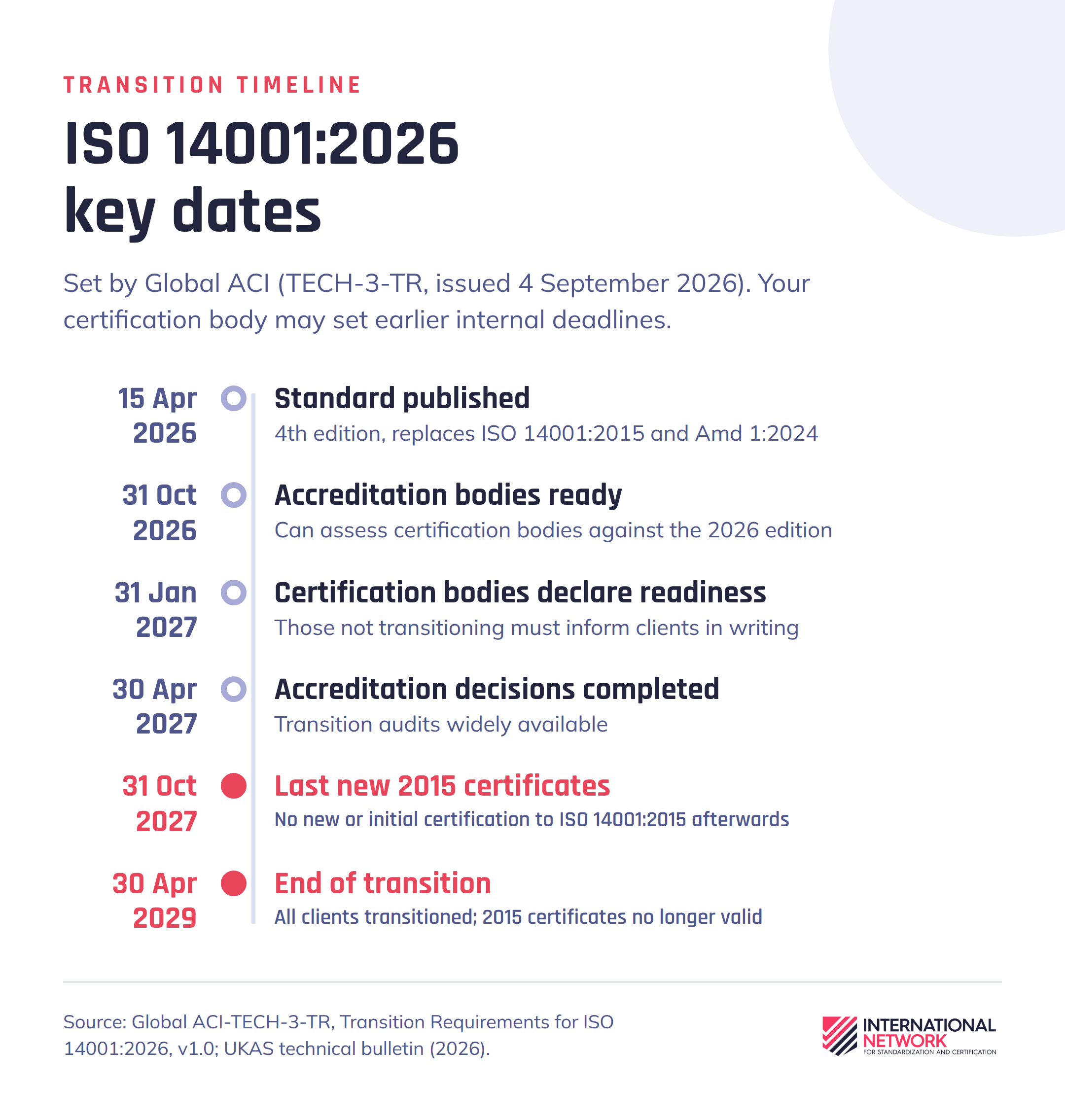
Global ACI issued its mandatory transition requirements for ISO 14001:2026 on 4 September 2026. Its announcement confirms a three-year transition period ending on 30 April 2029. Deadlines are counted from the last day of the publication month. The key dates:
| Date | Milestone | What it means for your company |
|---|---|---|
| 15 April 2026 | ISO 14001:2026 published | You can start preparing |
| 31 October 2026 | Accreditation bodies ready to assess certification bodies against the new edition | Your certification body is preparing |
| 31 January 2027 | Certification bodies declare readiness to their accreditation body; those not transitioning must tell clients in writing | Ask your certification body for its plan |
| 30 April 2027 | Accreditation bodies complete their transition decisions | Transition audits become widely available |
| 31 October 2027 | No new or initial certificates to ISO 14001:2015 after this date | First-time applicants should certify to the 2026 edition |
| 30 April 2029 | All clients transitioned, including certificate issue | ISO 14001:2015 certificates are no longer valid |
The British accreditation body UKAS published the same milestones in its technical bulletin. In the United States, ANAB’s guidance points to the Global ACI period and asks certification bodies to contact its EMS program. U.S. certification bodies are already accredited for the new edition. DQS Inc., for example, announced ANAB accreditation for ISO 14001:2026 in August 2026.
Your certification body may set earlier dates
Global ACI sets the outer limits. Certification bodies can set tighter internal cut-offs to spread their audit workload. PJR, for instance, publishes a transition plan under which all transition audits should be completed by 31 January 2029, three months before the official end. Ask your own registrar for its dates in writing. Do not plan against 30 April 2029 and discover in late 2028 that your auditor is booked.
How the transition audit works
The Global ACI document sets out the audit rules:
- The transition audit can be combined with a surveillance or recertification audit, or held as a separate special audit.
- It must cover the changed requirements, changes in your context, and any other changes needed in your system.
- Remote auditing is allowed under the existing Global ACI rules for information and communication technology.
- There is no fixed extra audit time. The certification body decides under ISO/IEC 17021-1 and the rules on audit time. The document notes that extra time may not be needed for a full system audit.
- Existing 2015 certificates do not have to be reissued with a shorter expiry date, although a certification body may do so.
- A company that does not transition loses its certification on 30 April 2029, even if its three-year cycle would run longer.
The most efficient route for most companies is to combine the transition with the next recertification or surveillance audit that falls in 2027 or 2028. Plan backward from that audit date.
Who needs to do what, and when
The right plan depends on where your company stands today. Four situations cover most U.S. small and mid-sized businesses.
You are certified and recertification falls in 2027 or 2028
This is the easiest case. Combine the transition with recertification. Start the gap analysis about nine months before the audit, so you have time to run an internal audit and a management review under the new requirements. Confirm with your certification body that it will be accredited for the 2026 edition by then.
You are certified and recertification falls after April 2029
Your current cycle will not carry you past the deadline. The transition must happen at a surveillance audit, or at a special audit, before 30 April 2029. Many companies in this position choose the surveillance audit in 2027 or 2028. Waiting for the last possible slot leaves no room for findings that need follow-up.
You plan to get certified for the first time
Build your system on ISO 14001:2026 from the start. Certificates to the 2015 edition can only be issued until 31 October 2027, and they would expire on 30 April 2029 anyway. There is no advantage in learning the old version first.
You run an integrated system with ISO 9001
Coordinate both transitions. ISO 9001:2026 brings similar changes in structure, so one project team, one gap analysis and, if your certification body agrees, one combined audit can save time and money. The section on integration below explains which elements you can share.
Questions to ask your certification body
- When will you be accredited for ISO 14001:2026, and by which accreditation body?
- What are your internal deadlines for transition audits?
- Can the transition be combined with our next surveillance or recertification audit?
- Will you add audit time, and if so, how much and why?
- Can parts of the audit be done remotely?
- When will the new certificate be issued, and what will its expiry date be?
Get the answers in writing and put the dates into your transition plan.
How to plan the ISO 14001:2026 transition
The following plan suits a small or mid-sized company with a working ISO 14001:2015 system. Larger multi-site groups need the same steps, run per site with central coordination.
Step 1: Get the standard and brief top management
Buy the standard from ISO or ANSI and read it in full. Then brief top management in 30 minutes: what changed, which dates apply, what the transition will cost in time, and who owns it. Clause 5 now stresses top management accountability, so their involvement is part of the evidence.
Step 2: Run a gap analysis
Go through the clause table above and mark each item: already met, partly met or missing. In a mature system, much of the work is updating existing documents. The real gaps usually sit in context, change management, external providers and audit objectives.
Step 3: Update context, interested parties and scope
Rework the context analysis with the named environmental conditions. Record whether climate change is relevant and why. Check whether customers or lenders impose climate or biodiversity requirements. Review the scope statement for the life cycle perspective.
Step 4: Revise aspects, risks and planning
Update the aspects register where the new context reveals new or changed aspects. Split risk and opportunity planning into the 6.1.4 and 6.1.5 structure. Separate emergency situations from abnormal operations in your risk assessment and emergency plans.
Step 5: Introduce planning of changes
Write a short change procedure or extend the ISO 9001 one. Test it on one real change before the audit so you have evidence.
Step 6: Tighten control of external providers
List all externally provided processes, products and services with environmental relevance. Set criteria, update contracts where needed, and decide how you will monitor them.
Step 7: Update audit programme, review and documents
Add objectives to the internal audit programme. Restructure the management review template into inputs and results. Run the wording updates through your manual and procedures. Then train the people affected, from the plant manager to the contractor coordinator.
Step 8: Prove it works, then book the audit
Run at least one internal audit against the 2026 requirements and one management review in the new format before the transition audit. Auditors look for evidence of use, not just new documents.
A worked example
Consider a hypothetical 85-person plastics injection molder in Ohio, certified to ISO 14001:2015 since 2019, with recertification due in June 2027. Its gap analysis shows three real gaps: no documented decision on biodiversity and resource availability, no change procedure, and weak control of the waste hauler and a subcontracted painting shop. Everything else needs only wording updates.
The environmental coordinator spends roughly four days on the context update and documents, two days on a change procedure borrowed from the company’s ISO 9001 system, and a day with purchasing on supplier criteria. The company runs an internal audit in March 2027 and a management review in April. It asks its certification body to combine the transition with the June recertification. Total internal effort is about two working weeks spread over five months, and there is no separate audit visit. That is the kind of result a well-run system can expect. A system that existed mainly for the certificate will need far more.
Integrating ISO 14001:2026 with ISO 9001 and ISO 45001
Many small and mid-sized companies hold both ISO 9001 and ISO 14001, and some add ISO 45001 for occupational health and safety. The timing now favors an integrated approach. ISO 9001:2026 was published in September 2026 and shares the harmonized structure with ISO 14001. According to DNV, the ISO 45001 revision reached the draft international standard stage in 2026, with publication expected in 2027.
The shared changes are obvious candidates for one combined procedure: planning of changes, audit objectives, the structured management review and control of externally provided processes. A single change procedure, one audit programme with objectives for each discipline, and one management review agenda with separate quality, environmental and safety sections can save real time. Ask your certification body whether it can combine the ISO 9001 and ISO 14001 transition audits.
Integration also supports the logic behind both standards. The seven quality management principles defined in ISO 9000, such as the process approach and evidence-based decision making, are just as useful for environmental management.
Does ISO 14001 actually improve environmental performance?
A fair question before spending money on a transition. The research is mixed, which is itself useful to know.
On the positive side, a study of about 3,000 U.S. facilities regulated as major sources under the Clean Air Act found that ISO 14001-certified facilities reduced their pollution emissions more than non-certified ones (Potoski and Prakash, 2005, Journal of Policy Analysis and Management). A 2025 study in Energy Efficiency by Cestau-Oyhantçabal and Arocena associated greater ISO 14001 adoption with lower energy intensity and greenhouse gas emissions. ISO’s launch announcement also cites a preliminary, not yet peer-reviewed study led by the Standards Council of Canada: across 83 countries from 1999 to 2022, a 1 percent increase in ISO 14001 certifications was associated with a 0.14 percent decrease in greenhouse gas emissions per unit of GDP.
On the cautious side, a study of U.S. transportation equipment manufacturers found that ISO 14001 reduced toxic releases only at the largest facilities, with no significant effect on off-site releases (Nemati, Zheng and Hu, 2019, Journal of Agricultural and Resource Economics). A systematic review of 94 peer-reviewed papers by Boiral and colleagues in the International Journal of Management Reviews warned that the literature tends to produce predictable and optimistic results and should be read critically.
Our reading: ISO 14001 works when the system is used to manage real environmental issues, and it does little when it exists to satisfy a customer questionnaire. The 2026 edition, with its stronger focus on results and evidence, pushes in the right direction. It cannot force a company to take the work seriously.
How many companies are certified?
ISO’s launch announcement cites more than 670,000 certified organizations worldwide, based on the ISO Survey 2024. The ISO Survey is now compiled from IAF CertSearch data. According to a DQS report on the ISO Survey 2025 results, there were 739,390 valid ISO 14001 certificates at the end of 2025, up from 676,232 a year earlier, an increase of about 9 percent.
ISO 14001 and U.S. regulations
ISO 14001 is voluntary in the United States. The EPA describes an environmental management system as a set of processes and practices that enable an organization to reduce its environmental impacts, and its page on EMS under ISO 14001 calls the ISO framework the most commonly used one. The EPA’s frequent questions on EMS make clear that ISO 14001 does not replace legal requirements. Certification does not exempt you from permits, reporting or inspections.
Federal procurement is a special case. FAR Subpart 23.4 allows agencies to implement environmental management systems, and the clause at FAR 52.223-19 applies to contractors that operate government-owned or government-leased facilities or vehicles where the agency uses an EMS. It does not name ISO 14001, and it does not require certification from typical suppliers. The executive orders behind federal sustainability policy have also changed since 2025, so check the current contract terms rather than relying on older summaries.
In our experience, the bigger driver for most small and mid-sized U.S. companies is the supply chain. Large customers often ask suppliers for ISO 14001 certification or an equivalent system. When the customer’s 2029 deadline arrives, an outdated certificate becomes a commercial problem.
Certification, accreditation and quality seals: keep them apart
An ISO 14001 certificate is only as credible as the body that issued it. Check that your certification body is accredited for ISO 14001 by a recognized accreditation body, such as ANAB in the United States, and that the certificate can be looked up in a public database such as IAF CertSearch. Our guides to third-party certification and to conformity assessment explain how certification and accreditation fit together.
Management system certification is also different from a quality seal. A seal such as those awarded by the United States Institute for Quality (USIQ) evaluates criteria like customer or employee experience. Quality-Standard.com and USIQ are operated by the same company. USIQ’s seal usage guidelines state that its seals are not a government approval or an accreditation, and that certified companies may not imply they are ISO certified because of a USIQ seal. Both kinds of assurance can be useful; they answer different questions. Our quality seal checklist shows how to judge any badge.
Common mistakes during the ISO 14001:2026 transition
- Waiting for 2029. The real deadline is your certification body’s last available audit slot, which may come months earlier.
- Rewriting the whole system. ISO calls the revision targeted. Update and connect what you have.
- Treating climate as a checkbox. A documented “climate change is relevant” with no link to aspects, risks or objectives will draw findings.
- Confusing life cycle perspective with LCA. You need to consider life cycle stages you can influence, not commission a full life cycle assessment.
- Forgetting suppliers. The wider wording on externally provided processes is one of the most practical changes. Waste haulers and subcontractors are where many real impacts sit.
- Relying on outdated sources. Some articles still say the standard is “expected in 2026,” quote IAF instead of Global ACI, or give the wrong end date. Use the Global ACI document and your registrar’s plan.
For a broader overview of management system standards, product standards and seals, see our guide to quality standards.

Frequently asked questions
When was ISO 14001:2026 published?
ISO published ISO 14001:2026 on 15 April 2026. It is the fourth edition of the standard, has 36 pages and replaces ISO 14001:2015 and its 2024 climate change amendment.
What is the ISO 14001:2026 transition deadline?
Under the Global ACI transition requirements, all certified organizations must complete the transition, including the issue of the new certificate, by 30 April 2029. After that date ISO 14001:2015 certificates are no longer valid. Your certification body may set earlier internal deadlines.
Can I still get certified to ISO 14001:2015?
Only until 31 October 2027. After that date, certification bodies may not issue new or initial certificates to the 2015 edition. A company starting now should aim for the 2026 edition directly.
What are the biggest changes in ISO 14001:2026?
The main changes are a broader, named set of environmental conditions in clause 4.1 (including climate change and biodiversity), a new clause 6.3 on planning changes, separate clauses for risks and opportunities and for action planning, wider control of externally provided processes, audit objectives, and a more structured management review.
Does the transition require an extra audit?
Not necessarily. The transition audit can be combined with a surveillance or recertification audit. Global ACI sets no fixed extra audit time; the certification body decides how much time is needed.
Is ISO 14001 required by law in the United States?
No. ISO 14001 is voluntary, and the EPA states that it does not replace legal requirements. Some customers and certain federal contracts ask for an environmental management system, which is why many U.S. suppliers choose certification.
Sources
- ISO. ISO 14001:2026 Environmental management systems: Requirements with guidance for use. iso.org/standard/92300.html
- ISO (2026). ISO 14001:2026 published (news release, 15 April 2026). iso.org
- ISO. ISO 14001: What has changed. iso.org
- ISO and IAF (2024). Joint communiqué on climate change amendments, 22 February 2024. iso.org (PDF)
- ISO. ISO 9001:2026 Quality management systems: Requirements. iso.org
- Global Accreditation Cooperation (2026). Global ACI-TECH-3-TR, Transition Requirements for ISO 14001:2026, version 1.0. global-aci.org (PDF)
- Global ACI (2026). Global ACI publishes transition requirements for ISO 14001:2026. global-aci.org
- UKAS. Technical bulletin: EMS ISO 14001:2026 transition. ukas.com
- ANAB. ISO 14001:2026 key changes and how to prepare. blog.ansi.org
- SGS. ISO 14001:2026 key updates and transition guidance. sgs.com
- PJR. ISO 14001:2026 transition plan. pjr.com
- Potoski and Prakash (2005). Covenants with weak swords: ISO 14001 and facilities’ environmental performance. Journal of Policy Analysis and Management 24(4), 745-769. doi.org/10.1002/pam.20136
- Nemati, Zheng and Hu (2019). The ISO 14001 Standard and Firms’ Environmental Performance: Evidence from the U.S. Transportation Equipment Manufacturers. Journal of Agricultural and Resource Economics 44(2), 422-438. ageconsearch.umn.edu
- Boiral, Guillaumie, Heras-Saizarbitoria and Tayo Tene. Adoption and outcomes of ISO 14001: a systematic review. International Journal of Management Reviews. doi.org/10.1111/ijmr.12139
- Cestau-Oyhantçabal and Arocena (2025). Greener standards, cleaner production? Empirical evidence from ISO 14001 adoption. Energy Efficiency. doi.org/10.1007/s12053-025-10400-7
- U.S. EPA. EMS under ISO 14001; Frequent questions about environmental management systems. epa.gov
- Federal Acquisition Regulation, Subpart 23.4. acquisition.gov
- DQS (2026). ISO Survey 2025 results. dqsglobal.com