Ask ten people in a company what a quality standard is and you will hear ten different answers. The quality manager thinks of ISO 9001. The engineer thinks of a tolerance on a drawing. The buyer thinks of a supplier requirement, and the HR lead thinks of the employer seal on the careers page. All of them are partly right, and that is why the term causes so much confusion in meetings, tenders and contracts.
Much of the confusion comes from two questions that people rarely ask out loud: is this a formal standard from a recognized body or a company’s own rule, and has anyone independent checked that it is met? Both run through this guide, from the international definitions and the people who write standards in the United States to the point where a voluntary standard becomes legally binding.
In short: A quality standard is a document that sets out agreed requirements, guidelines or characteristics that a product, service, process, management system or organization should meet so that its quality is consistent, comparable and verifiable. Formal standards are developed by consensus and approved by a recognized body such as ISO or an ANSI-accredited developer. They are voluntary unless a law, regulation or contract makes them binding. A standard defines the criteria; certification is the separate step in which an independent body checks whether those criteria are met.
What is a quality standard?
The most widely cited definition of a standard comes from ISO/IEC Guide 2, the vocabulary that ISO and IEC use for standardization itself. It describes a standard as a document, established by consensus and approved by a recognized body, that provides rules, guidelines or characteristics for activities or their results, for common and repeated use, aimed at the optimum degree of order in a given context. A note adds that standards should be based on the consolidated results of science, technology and experience.
Four parts of that definition matter in practice. A standard is written down; an unwritten habit, however good, does not count. Its content is agreed among the parties concerned instead of being set by one company, and while consensus does not require unanimity, sustained objections have to be dealt with. A recognized body publishes it, for example ISO, IEC, a national standards body or an accredited standards developer. And it is meant for common and repeated use by many users, which is what makes results comparable.
A quality standard is a standard whose purpose is to define, achieve or demonstrate quality. ISO 9000, the fundamentals and vocabulary standard for quality management, defines quality as the degree to which a set of inherent characteristics of an object fulfils requirements. Put the two definitions together and you get a practical working definition: a quality standard tells you which requirements matter and how you can show that they are met.
In everyday business language the term is used more loosely. Many companies call their own internal specifications “our quality standards”, and service providers use it for promises such as “every call answered within 30 seconds”. Those are standards in the broad sense: written, repeatable criteria. What they lack is the consensus process and the recognized publisher, so they carry less weight with outsiders. Keep that distinction in mind, because it explains why a customer will accept an ISO 9001 certificate without discussion but will want to see evidence for a company’s self-declared standard.
The quality standards our network works with are listed on the quality standards page.
Quality, standard, requirement: three terms that need to be clear
Discussions about quality standards often go wrong because people use the same words for different things. Three of them cause most of the trouble.
Quality. Quality pioneers defined it in different ways. Joseph Juran spoke of “fitness for use”, which looks at quality from the user’s side. Philip Crosby defined quality as “conformance to requirements”, which looks at it from the producer’s side. ISO 9000 combines both views: the requirements come from customers and other interested parties, and quality is the degree to which the object fulfils them. David Garvin added a useful reminder in the 1980s that quality has several dimensions, among them performance, features, reliability, conformance, durability, serviceability, aesthetics and perceived quality. A standard rarely covers all of them. It is worth checking which of them a given standard addresses.
Standard. In the strict sense, a consensus document from a recognized body, as described above. In the loose sense, any written benchmark. When a contract says “according to the applicable quality standards”, ask which documents are meant. Vague references like that are a common source of disputes.
Requirement. A requirement is a need or expectation that is stated, generally implied or obligatory. In a formal standard, requirements are the parts you must fulfil to claim conformity. Everything else in the document helps you understand or implement them.
A fourth term often joins the confusion: specification. A specification is usually narrower and tied to one product, project or customer, for example a drawing with tolerances or a purchase specification. A standard is meant for many users. In practice, specifications often refer to standards (“material per ASTM A36”), which is how general standards reach individual products.
A short history of quality standards
Weights and measures have been standardized for thousands of years, but quality standards in today’s sense came with industrial mass production. Interchangeable parts only fit when every part meets the same dimensions, so engineering societies and manufacturers began publishing shared specifications in the late 19th century. In October 1918, three U.S. government agencies and five private organizations formed the American Engineering Standards Committee, the predecessor of ANSI. ISO was founded in 1947 to coordinate standards across countries after the Second World War.
Military purchasing moved the focus from the product to the system that makes it. The U.S. Department of Defense’s MIL-Q-9858 from 1959 required suppliers to run a documented quality program instead of relying on final inspection by the buyer. The British standard BS 5750, published in 1979, brought this approach into civilian industry and became the model for ISO 9001, first published in 1987 together with ISO 9002 and ISO 9003.
Since then the same logic has spread far beyond the factory floor. There are now management system standards for the environment, information security, occupational safety and food, standards for call centers and complaint handling, and survey-based standards that measure how employees and customers experience an organization.
What a quality standard contains
Formal standards follow a predictable structure. ISO and IEC set out the rules for structure and drafting in the ISO/IEC Directives, Part 2, and most national and industry standards developers use something similar. Once you know the pattern, any standard becomes much easier to read.
| Part | What it does | What to look for |
|---|---|---|
| Foreword and introduction | Explains who developed the document, what changed from the previous edition and the underlying concepts | The edition and year, and whether a transition period applies |
| Scope | Defines what the standard covers and what it does not | Whether your product, service or organization falls inside it |
| Normative references | Lists other documents that are indispensable for applying this one | Additional standards you will need to buy and follow |
| Terms and definitions | Fixes the meaning of key words for this document | Words that mean something narrower than in everyday use |
| Requirements clauses | The core: what must be done, measured or documented | Every “shall”; these are the points an auditor checks |
| Annexes | Normative annexes add requirements; informative annexes give guidance and examples | The label “normative” or “informative” in the annex heading |
| Bibliography | Further reading that is not required for conformity | Useful background, nothing more |
The single most useful reading skill is knowing the verbal forms. ISO standards use them consistently: “shall” indicates a requirement, “should” a recommendation, “may” a permission and “can” a possibility or capability. A requirement, in the words of the Directives, conveys objectively verifiable criteria from which no deviation is permitted if conformance is to be claimed. In other words, if a clause says “shall”, you have to do it to claim conformity. If it says “should”, you are expected to consider it, and an auditor may ask why you chose differently, but it is not a nonconformity on its own.
When a team starts working with a new standard, it helps to have someone mark every “shall” in a different color. The resulting list is the closest thing to a checklist the standard offers, and it usually turns out shorter than people fear.
Types of quality standards
Quality standards can be grouped by what they apply to. The boundaries are not sharp, and some documents fall into more than one group, but the categories help you understand what a certificate or claim covers.
| Type | What it sets requirements for | Examples |
|---|---|---|
| Management system standards | How an organization plans, controls and improves its work | ISO 9001 (quality), ISO 14001 (environment), ISO 45001 (occupational health and safety), ISO/IEC 27001 (information security) |
| Product standards | Characteristics of a product such as dimensions, performance, safety or materials | ASTM material specifications, UL safety standards, IEC standards for electrical equipment |
| Process standards | How a specific activity is carried out | Welding procedures, good manufacturing practice (GMP), sterilization methods |
| Service standards | How a service is delivered and how customers are treated | ISO 10002 (complaints handling), ISO 18295 (customer contact centers) |
| Testing and measurement standards | How properties are measured so that results are comparable | ASTM test methods, ISO/IEC 17025 for testing and calibration laboratories |
| Terminology standards | The meaning of words in a field | ISO 9000 (quality management vocabulary), ISO/IEC 17000 (conformity assessment vocabulary) |
| Workplace and employer standards | Working conditions, HR practices and how employees experience their employer | ISO 45001, ISO 30414 (human capital reporting), survey-based employer standards such as Top Employer criteria |
A second useful split is between requirements standards and guidance standards. A requirements standard such as ISO 9001 contains “shall” statements and can be used for certification. A guidance standard such as ISO 9004 or ISO 10002 mainly contains “should” statements. It helps you improve, but there is nothing to certify against in the strict sense. If someone offers you a certificate “according to” a pure guidance standard, ask what exactly was assessed.
A third split is by origin. De jure standards come out of a formal consensus process. De facto standards become standards because the market adopts them, like a file format or an industry practice that everyone copies. Company standards are written by one organization for its own use or for its suppliers. All three exist side by side, and a single product often has to meet all of them at once.
Who sets quality standards?
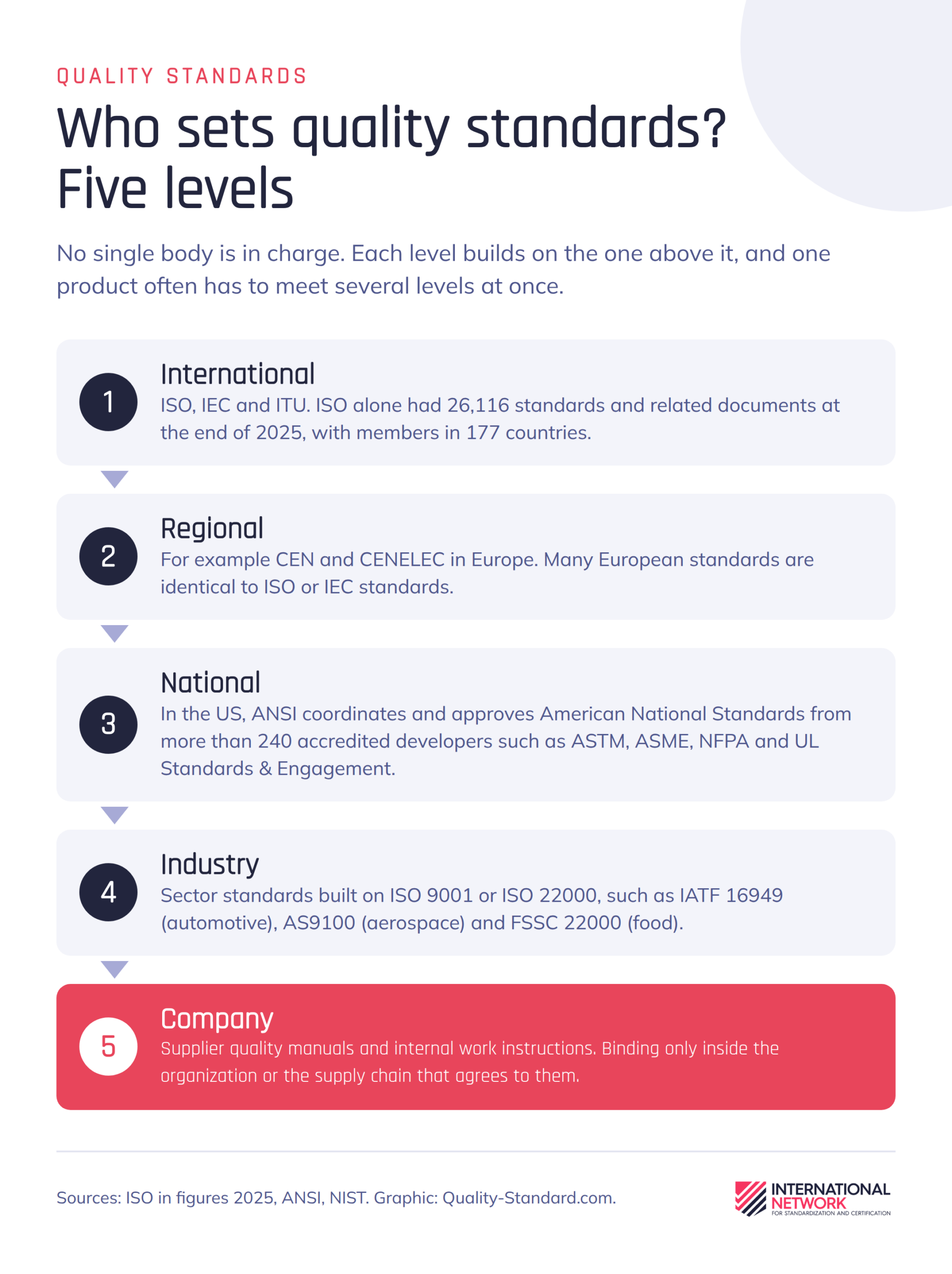
Standards come from several levels that build on one another, and no single body is in charge of all of them.
International. ISO, IEC and ITU are the three big international standards organizations. ISO alone had more than 26,000 International Standards and related documents in its catalogue at the end of 2025 and published 1,493 new ones that year. Its members are the national standards bodies of 177 countries, one per country. IEC covers electrical and electronic technology, and ITU covers telecommunications.
Regional. In Europe, CEN and CENELEC publish European standards that member countries must adopt as national standards. Many of them are identical to ISO or IEC standards.
National. In most countries a single body, often government-related, runs national standardization. The United States works differently. Its system is market-driven and led by the private sector. The American National Standards Institute (ANSI) coordinates it but does not write standards itself. Instead, ANSI approves American National Standards developed by more than 240 independent ANSI-Accredited Standards Developers once ANSI’s due process requirements have been met. Well-known developers include ASTM International, ASME, NFPA, UL Standards & Engagement and NSF. ANSI is also the U.S. member of ISO.
Industry. Many sectors build their own quality standards on top of the international ones. The automotive industry uses IATF 16949, aerospace uses AS9100 from the International Aerospace Quality Group, and food safety relies on schemes such as FSSC 22000 built on ISO 22000. These documents usually take ISO 9001 or ISO 22000 as a base and add sector-specific requirements.
Company. Large buyers write supplier quality manuals, and almost every organization has internal work instructions. These are standards for their users, but only within the organization or the supply chain that agrees to them.
The government’s role in the United States is mainly that of a user and participant. The National Technology Transfer and Advancement Act (NTTAA) directs federal agencies to use voluntary consensus standards wherever possible instead of writing their own government-unique standards. OMB Circular A-119, last revised in 2016, sets out how agencies should do this, and NIST coordinates federal participation. This is one reason why private standards such as those from ASTM or ISO end up in federal regulations.
How a quality standard is developed
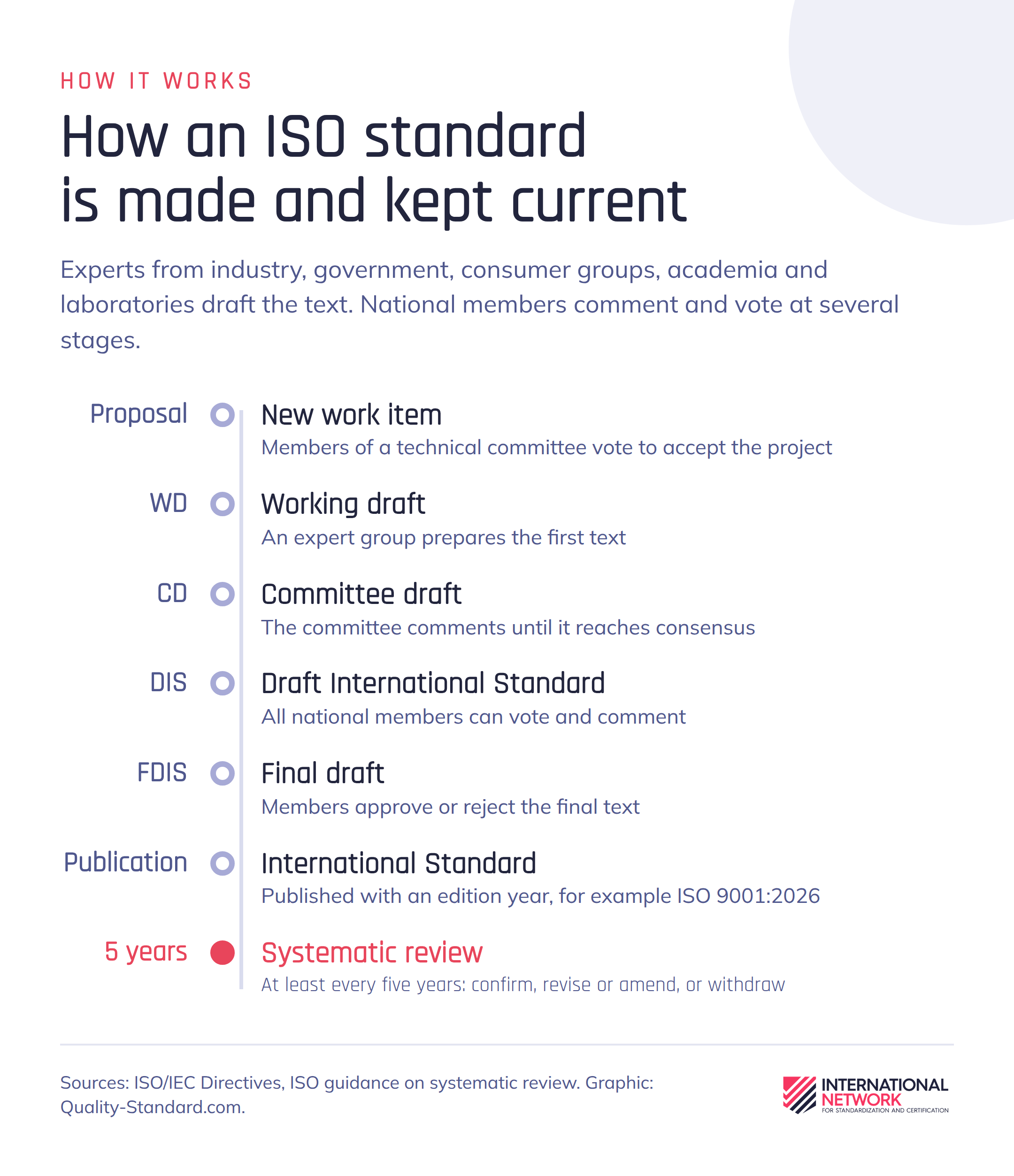
Formal standards are written by committees of experts from industry, government, consumer groups, academia and test laboratories. At ISO, a proposal for a new standard has to be accepted by the members of a technical committee before drafting starts. The draft then passes through several stages: a working draft prepared by experts, a committee draft circulated for comments, a Draft International Standard on which all national members can vote and comment, and a Final Draft International Standard that is approved or rejected. Only then is the standard published.
Three principles make the result different from a document written by a single company:
- Consensus. Comments have to be considered and objections resolved. That takes time, often several years for a major standard, but it gives the result broad acceptance.
- Openness and transparency. Interested parties can take part and see what is being worked on. The WTO Committee on Technical Barriers to Trade agreed in 2000 on six principles for international standards: transparency, openness, impartiality and consensus, effectiveness and relevance, coherence, and addressing the concerns of developing countries.
- Review. Every ISO International Standard is reviewed at least every five years. The members then vote to confirm it, revise or amend it, or withdraw it.
The review cycle explains why standards have edition years. ISO 9001 is a good example. After a systematic review, the 2015 edition was revised, and ISO 9001:2026 was published on 16 September 2026. Certified organizations now have a transition period to move to the new edition. Our article on ISO 9001:2026 explains what changed. The environmental standard went through the same process; see ISO 14001:2026.
For users this has a practical consequence: always check which edition a contract, certificate or regulation refers to. “ISO 9001” without a year is ambiguous during a transition. A regulation may even refer to an older edition on purpose, as the FDA example in the next section shows.
Are quality standards voluntary or mandatory?
In principle, standards are voluntary. The WTO Agreement on Technical Barriers to Trade draws the line clearly. A standard is a document approved by a recognized body with which compliance is not mandatory. A technical regulation lays down product characteristics or related processes with which compliance is mandatory. The same content can be either, depending on who requires it.
In practice, a voluntary standard becomes binding in three ways.
1. Through law or regulation. Regulators often incorporate standards by reference instead of writing technical details themselves. A current example: on 2 February 2026, the FDA’s Quality Management System Regulation (QMSR) took effect for medical device manufacturers. It incorporates ISO 13485:2016 and clause 3 of ISO 9000:2015 by reference into 21 CFR Part 820. For device makers, a former voluntary quality standard is now the core of a federal regulation. The rule names specific editions, so a later revision of ISO 13485 does not become binding for device makers on its own.
2. Through contracts. Customers write standards into purchase orders, supplier agreements and tenders. Many large manufacturers require ISO 9001 or a sector standard from their suppliers. Legally, the obligation then comes from the contract, not from the standard.
3. Through market expectations. Nothing forces a company to be certified, but if every competitor holds a certificate and buyers filter by it, the choice is only voluntary on paper.
There is also a liability angle. In product liability cases, courts often look at whether a product met recognized standards. Meeting a standard does not automatically protect a company, and ignoring one is hard to defend. For that reason, legal advice is worth getting whenever standards appear in contracts or regulated products.
Standard, certification, accreditation and seal: how they fit together
These terms are often mixed up, even in marketing material, although they describe different steps in one chain.
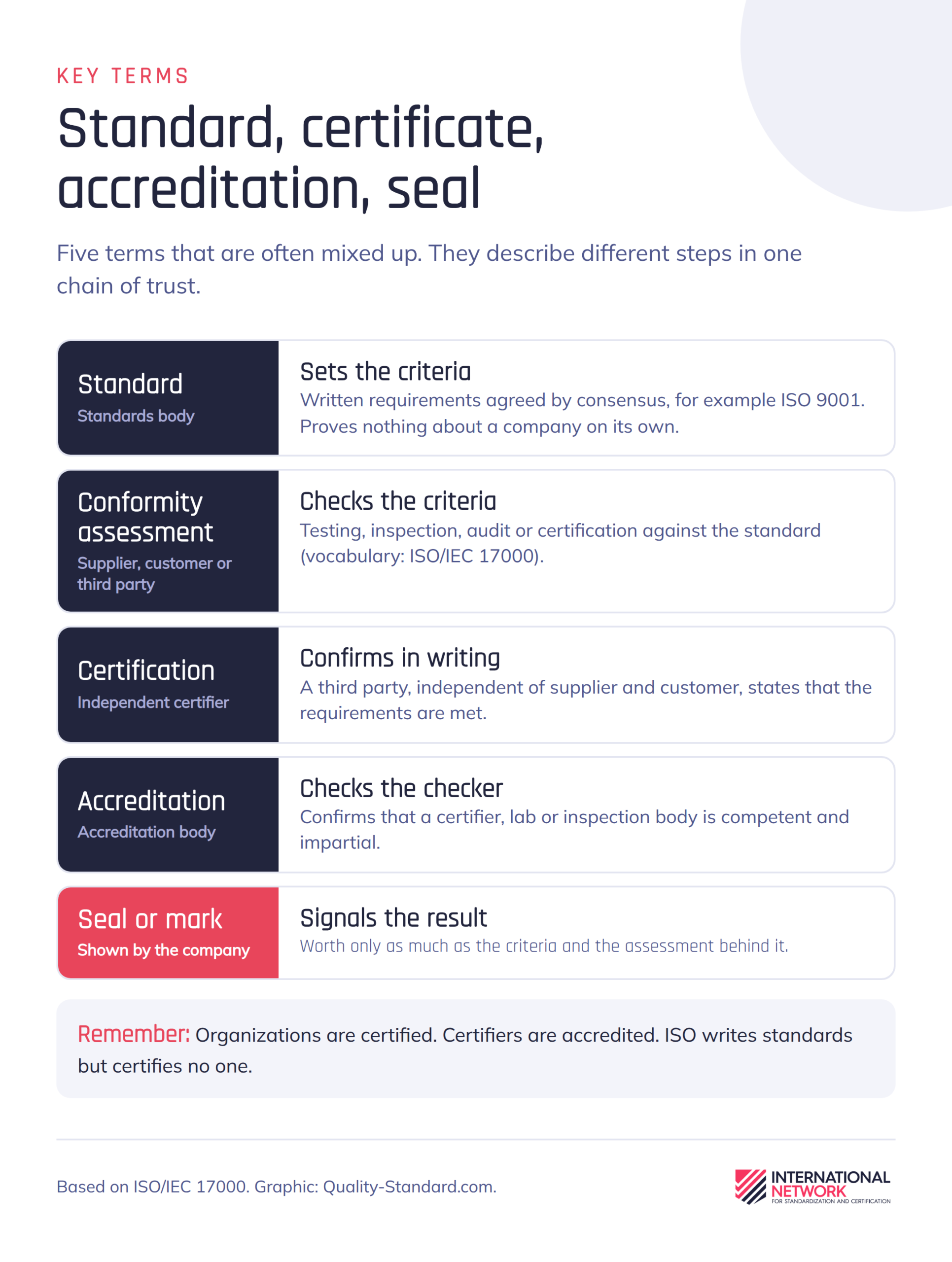
- Standard: sets the criteria. It says what good looks like.
- Conformity assessment: checks whether the criteria are met, through testing, inspection, audit or certification. ISO/IEC 17000 is the vocabulary for this field.
- Certification: a third party, independent of supplier and customer, confirms in writing that the requirements are met. The result is a certificate, often with a mark.
- Accreditation: an accreditation body confirms that a certifier, laboratory or inspection body is competent and impartial. Organizations are certified; certifiers are accredited.
- Seal or mark: the visible sign of a positive result. Its value depends entirely on the criteria and the assessment behind it.
A standard on its own proves nothing about a specific company; that takes a credible assessment against it. The details are explained in our guides to conformity assessment and third-party certification, and our 10-point check for seals and badges shows how to verify a certificate in a few minutes.
One more distinction matters when a company says it “complies with” a standard. Compliance can be self-declared (first party), checked by a customer (second party) or confirmed by an independent body (third party). All three are legitimate. They carry different weight, and a buyer is entitled to ask which one is meant.
Examples of quality standards by industry
The following table shows widely used quality standards. It is not complete, but it covers the documents most often requested in U.S. and international supply chains.
| Industry or topic | Standard | Focus |
|---|---|---|
| All sectors | ISO 9001 | Quality management system; the most widely certified management system standard |
| Automotive | IATF 16949 | Quality management for automotive production and service parts, built on ISO 9001 |
| Aerospace and defense | AS9100 | Quality management with added requirements for safety, configuration and product integrity |
| Medical devices | ISO 13485 | Quality management for regulatory purposes; incorporated into FDA’s QMSR |
| Food | ISO 22000, FSSC 22000 | Food safety management across the food chain |
| Laboratories | ISO/IEC 17025 | Competence, impartiality and consistent operation of testing and calibration labs |
| Information security | ISO/IEC 27001 | Information security management system |
| Environment | ISO 14001 | Environmental management system; current edition 2026 |
| Occupational health and safety | ISO 45001 | Prevention of work-related injury and ill health |
| Customer service | ISO 10002, ISO 18295 | Complaints handling; requirements for customer contact centers |
According to the ISO Survey 2024, more than 1.47 million ISO 9001 certificates were valid worldwide, far more than for any other management system standard, with ISO 14001 second at around 676,000. Each of those organizations is audited again during its certification cycle.
ISO 9001 is also the standard most people mean when they say “quality standard”. Its requirements rest on seven quality management principles, from customer focus to relationship management, which are explained in our article on the seven quality management principles.
Quality standards for services and employers
Most classic quality standards were written with manufacturing in mind. Services and workplaces raise a different problem: much of their quality only shows up in the experience of the people on the receiving end. You can measure the diameter of a bolt. Whether a customer felt taken seriously, or whether employees trust their managers, can only be measured by asking them.
For services, research has long described what customers judge. The SERVQUAL model by Parasuraman, Zeithaml and Berry names five dimensions: tangibles, reliability, responsiveness, assurance and empathy. Formal standards cover parts of this. ISO 10002 gives guidance on handling complaints, and ISO 18295 sets requirements for customer contact centers. Many service quality standards combine documented processes with customer surveys, because the process alone cannot show how the service is perceived. Our article on service quality standards goes deeper into how this can be measured.
For employers, a workplace quality standard usually combines two sources of evidence: a confidential survey of employees and an assessment of HR practices against published criteria. The survey shows how the workplace is experienced, and the HR assessment shows whether policies and processes exist and work. One example is the Top Employer method of the United States Institute for Quality (www.usiq.org), the partner institute of our network in the U.S. It scores an employee survey and an HR assessment of 39 criteria separately, requires minimum results in each part, and makes every certificate verifiable through a public record with the exact issue and expiry dates. The full criteria are published in the USIQ Top Employer methodology. Our guides on workplace quality standards and family-friendly workplace standards explain which criteria such standards should cover.
For transparency: Quality-Standard.com and USIQ are both operated by Quality Standardization and Certification LLC. The partner institutes in our network apply comparable methods in their markets, for example DIQP in Germany and ÖIQP in Austria. All partner institutes are listed on the partners page. Apply the same critical questions to these standards as to any other.
Survey-based standards and ISO certificates answer different questions. An ISO 9001 certificate shows that processes are controlled, while feedback from customers and employees shows how the result is experienced. Many organizations use both.
Why quality standards matter
Economists have tried to put a number on the effect of standards. A study by the Centre for Economics and Business Research for the British Standards Institution found that standards contributed to 37.4% of annual labour productivity growth in the UK and 28.4% of annual GDP growth, equivalent to £8.2 billion in 2013. In the company survey for the same study, 84% of businesses said that using standards had enhanced their reputation. The figures come from one country and one methodology, so treat them as an indication of scale rather than a forecast for your company.
For a single company, the benefits are more down to earth. Work is done the same way regardless of who does it, which cuts errors, rework and complaints. Customers can compare offers because they are measured against the same criteria. Many tenders and supplier programs require specific standards or certificates, so a company without them is often not even considered.
Trust is the other big reason. A recognized standard, checked by an independent body, lowers the risk for a buyer who does not know the supplier yet. Consumers react to this signal too, as research on how seals of approval affect consumer behaviour shows. And a good standard condenses the experience of many organizations, so working through it often reveals gaps that a company would otherwise only find after something has gone wrong.
There are costs too: buying the standards, implementation time, internal audits and certification fees. A standard also only helps if people actually work by it. When the quality manual says one thing and daily work follows other rules, a good auditor will usually find the gap.
How to choose and apply a quality standard
The right standard depends on what you want to prove and to whom. These steps help:
- Clarify the purpose. Do customers or regulators require a specific standard, or do you want to improve on your own? Required standards come first.
- Define the object. Is it about the whole organization, a product line, a service, a site or the workplace? That determines the type of standard.
- Check sector standards. In regulated or demanding sectors, a sector standard such as IATF 16949, AS9100 or ISO 13485 may be expected instead of, or in addition to, ISO 9001.
- Get the current edition. Buy the standard from the publisher or a national body, and check whether a new edition and transition period are coming.
- Run a gap analysis. Compare every requirement with your current practice. List what exists, what is missing and who is responsible.
- Implement and document. Close the gaps, train people and keep the evidence that auditors will want to see.
- Measure and review. Internal audits, customer and employee feedback, and management reviews show whether the standard is working.
- Decide on certification. If outsiders need proof, choose a certifier whose scope covers your standard and, where relevant, who is accredited for it.
Small companies sometimes worry that formal standards are only for large corporations. Most management system standards are written to scale, though, and a ten-person firm can meet the requirements with a few clear procedures and simple records. The system has to fit the size and risks of the organization.
Common misconceptions about quality standards
“A quality standard guarantees a good product.” It guarantees that defined requirements are met. If the requirements are weak, or if they cover processes rather than the product, a certified company can still deliver mediocre results. Check what the standard measures.
“ISO certifies companies.” ISO develops and publishes standards. It does not certify anyone. Certification is done by independent certification bodies, which are in turn accredited by accreditation bodies.
“Standards are written by the government.” In the United States, most standards are developed by private organizations with government participation. Agencies then use them, sometimes by incorporating them into regulations.
“Once certified, always certified.” Certificates have an expiry date and are subject to surveillance. They can be suspended or withdrawn. Always check the current status, not just the PDF.
“There are seven quality standards.” This mixes up the seven quality management principles of ISO 9000 with the standards themselves. There are thousands of quality-related standards. The seven principles are the ideas behind the ISO 9000 family.
“Our internal standard is as good as an ISO standard.” It may be better for your purposes. But it lacks the consensus process and the recognized publisher, so outsiders cannot rely on it in the same way unless it is independently assessed.

Frequently asked questions about quality standards
What is a quality standard in simple terms?
A quality standard is an agreed, written set of requirements that describes how good a product, service, process or organization has to be and how this can be checked. It makes quality consistent within a company and comparable between companies.
What is an example of a quality standard?
The best-known example is ISO 9001, the international standard for quality management systems. Other examples are IATF 16949 for the automotive industry, AS9100 for aerospace, ISO 13485 for medical devices, ISO/IEC 17025 for laboratories and ISO 10002 for complaints handling.
What is the difference between a quality standard and quality control?
The standard defines the requirements. Quality control is the activity of checking products or services against those requirements, for example through inspections and tests. Quality assurance and quality management are broader and cover the whole system that prevents errors in the first place.
Is a quality standard a legal requirement?
Usually not. Standards are voluntary by definition. They become binding when a law or regulation incorporates them, such as ISO 13485 in the FDA’s QMSR for medical devices, or when a contract requires them.
Who creates quality standards?
International standards come from ISO, IEC and ITU. In the United States, more than 240 ANSI-accredited developers such as ASTM International, ASME and UL Standards & Engagement write American National Standards. Industry groups and individual companies also publish their own standards.
How often are quality standards updated?
ISO reviews every International Standard at least every five years and then confirms, revises or withdraws it. Major standards like ISO 9001 are revised roughly every decade; the current edition was published in September 2026.
Can a company create its own quality standard?
Yes, and many do, for example in supplier requirements or service promises. These internal standards are useful, but outsiders give them less weight than consensus standards unless an independent body has assessed them.
Sources
- IEC Electropedia: definition of “standard” from ISO/IEC Guide 2:2004, 3.2
- ISO: ISO/IEC Guide 2:2004, Standardization and related activities, General vocabulary
- ISO: Foreword, verbal forms “shall”, “should”, “may” and “can”
- ISO in figures (status 31 December 2025)
- ISO Annual Report 2025
- ISO: What we do (members in 177 countries)
- ISO: Guidance on the systematic review process
- ANSI: Standards FAQs
- NIST: NTTAA and OMB Circular A-119
- WTO: Agreement on Technical Barriers to Trade, Annex 1
- WTO: Six principles for the development of international standards
- FDA: Quality Management System Regulation (QMSR)
- Federal Register: Medical Devices; Quality System Regulation Amendments (2024)
- Cebr: Standards contribute £8.2 billion to UK economy (2015)
- Cebr: survey results on the business benefits of standards (2015)
- NIST IR 5122: Questions and answers on quality, the ISO 9000 standard series (history of MIL-Q-9858 and BS 5750)
- ISO: History of ISO
- Standards Portal (ANSI): The U.S. standardization system and its history
- ISO: The ISO Survey
- USIQ: Top Employer methodology